

The Ministry of Unification is set to revitalize the North-South dialogue and cooperation organizations that were downsized during the Yoon Suk Yeol administration through a comprehensive reorganization. However, critics argue that the complete elimination of the department responsible for North Korean human rights—a universal value—indicates that the government’s policy direction has become overly aligned with its political ideology.
According to the Ministry of Unification on Tuesday, the new restructuring plan aims to normalize the Ministry’ by refocusing on its core functions of talks and exchanges.
The plan proposes an increase in staff from 533 to 600, adding 67 positions, while maintaining a structure of three divisions and three bureaus. Two new offices will be added under the headquarters: the North-South Talks Headquarters and the Peace Cooperation Zone Promotion Team. Additionally, a new Peace Exchange Office (formerly the Exchange Cooperation Bureau) will be established to handle inter-Korean exchange and cooperation functions.
The Peace Exchange Office will be responsible for developing and overseeing policies related to inter-Korean exchanges and cooperation. It will support local government projects involving North-South exchanges, manage laws and systems related to strategic exports to North Korea, monitor sanction trends, promote economic cooperation projects, and collaborate on border cooperation and climate initiatives.
The word peace emerges as a central theme in this reorganization. Among the three divisions and three bureaus, the term peace appears in one division and one bureau, reaffirming the administration’s commitment to emphasizing peaceful cooperation throughout its organizational structure.
The Peace Cooperation Zone Promotion Team will consist of two offices: one focused on planning for the Peace Economic Zone and strategies to resume operations at the Kaesong Industrial Complex, and another dedicated to supporting the normalization of business operations for companies in the Kaesong Industrial Complex while overseeing the Kaesong Industrial Complex Support Foundation.
Previously, the Yoon administration significantly reduced the departments related to inter-Korean exchanges and cooperation in September 2023, cutting 81 positions from the Ministry of Unification’s total staff. That reorganization consolidated the functions of four organizations—the North-South Talks Headquarters, the Exchange Cooperation Bureau, the North-South Cooperation Zone Development Planning Team, and the North-South Entry Office—into a single entity. In response to the prolonged suspension of inter-Korean exchanges, the Ministry reduced functions related to exchanges, meetings, and entry while bolstering those focused on North Korean human rights and information analysis.
However, the current reorganization will eliminate the Human Rights and Humanitarian Affairs Office, which was dedicated to addressing North Korean human rights issues prioritized by the Yoon administration. Instead, a Social and Cultural Cooperation Bureau will be established to promote inter-Korean social and cultural exchanges and to address humanitarian issues such as separated families. This bureau will support various private exchanges and enhance efforts related to separated families, abductees, and North Korean defector resettlement.
Notably, this reorganization appears to reinforce a stance of not publicizing the human rights issues that North Korea seeks to avoid. It retains the bid for the North Korean Human Rights Center, previously promoted as a North Korean Holocaust Museum, and has halted the publication of reports documenting human rights abuses experienced by North Korean defectors.
While the normalization of the Ministry of Unification is crucial, some argue that the reorganization is too closely aligned with the preferences of the current administration. Critics suggest that the government is adopting an overly cautious approach to entice North Korea into dialogue.
The revival of the organization related to the Kaesong Industrial Complex (the Peace Cooperation Zone Promotion Team) has also faced criticism for not aligning with the government’s stated emphasis on practicality and realism. Despite arguments for accepting North Korea’s two-state theory from a realistic perspective, the establishment of a dedicated organization amid the prolonged closure of the Kaesong Industrial Complex and North Korea’s unauthorized use of its facilities is seen by some as an impractical use of resources.
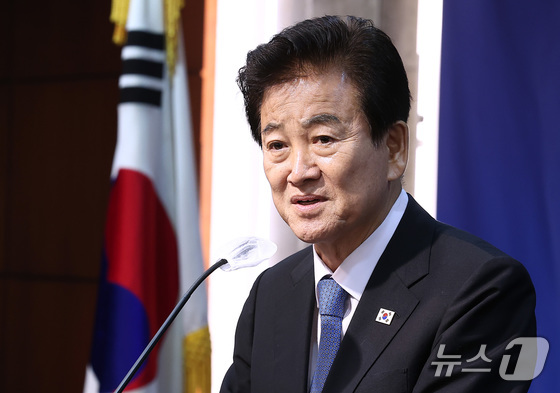
Observers speculate that this decision strongly reflects the vision of Chung Dong-young, who, as the first Minister of Unification in 2004, opened the Kaesong Industrial Complex. During his campaign for the 17th presidential election, Chung even branded himself as Kaesong Dong-young, merging the industrial complex policy—a core value of his campaign—with his name.