


Last year, five communication base stations in South Korea experienced reception disruptions due to suspected global positioning system (GPS) jamming attacks attributed to North Korea. This incident affected 3,694 aircraft and 1,782 vessels.
On Thursday, during a National Assembly audit of the Korea Aerospace Administration conducted by the Science, Information and Communication Technology (ICT), Broadcasting, and Communications Committee, Representative Lee Sang-hwi of the People Power Party disclosed documents submitted by the Ministry of Science and ICT and the Central Radio Management Office.
Representative Lee stated that the airspace over the Korean Peninsula is vulnerable to GPS attacks. From a security standpoint, these figures indicate a virtually defenseless state.
Representative Lee’s scrutiny of the Korea Aerospace Administration arises from the agency’s ongoing efforts to develop the Korean Positioning System (KPS).
He argued for reducing reliance on GPS—which the U.S. Space Force made freely available to civilians decades ago—and for accelerating the development of a domestically produced positioning system. This position underscores the need to secure technological sovereignty for national security, effectively endorsing the KPS initiative.
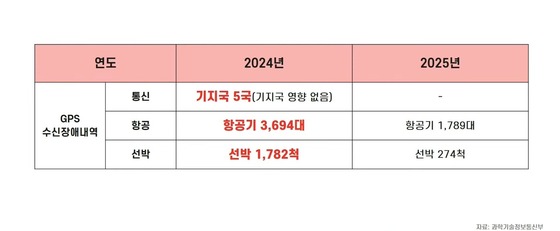
Representative Lee emphasized that most aspects of the citizens’ daily lives depend on GPS, including finance, security, and navigation. South Korea uses GPS operated by the U.S. Space Force at no cost. Doesn’t this mean the U.S. could potentially control it at will?
In response, Yoon Young-bin, head of the Korea Aerospace Administration, acknowledged that it recognizes that GPS jamming is a serious security issue. The widespread assumption that GPS would always be available has delayed the development of its own positioning system.
The KPS project aims to develop a regional satellite navigation system that provides ultra-precise positioning, navigation, and timing information tailored for the Korean Peninsula and its surrounding areas. This interagency initiative will invest approximately 3.7 trillion KRW (about 2.6 billion USD) by 2035. The Korea Aerospace Administration plans to launch a total of eight satellites by 2035, beginning with the first satellite on September 1, 2029, to complete the KPS network.