

Recent evidence suggests that while North Korea has categorized South Korea as one of the two hostile nations, it has not dismantled the key figures and organizations that have played crucial roles in inter-Korean or North Korea-U.S. dialogues. In fact, the activities of these individuals have become increasingly prominent lately.
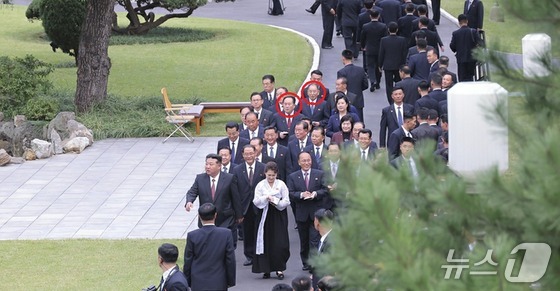
On October 10, North Korea held various events to commemorate the 80th anniversary of the founding of the Workers’ Party of Korea. During a visit to the Party Founding Museum on October 9, Kim Jong Un, the Party’s General Secretary, was seen accompanied by Ri Son-gwon, a department head of the Party Central Committee, and Kim Yong-chol, an advisor to the United Front Department.
Ri Son-gwon, who previously oversaw North Korea’s South Korea-related affairs as the head of the United Front Department, is a former military official who has represented North Korea in several high-level inter-Korean talks. He gained notoriety for his cold noodles remark while serving as the chief representative during the 2018 North Korea-U.S. denuclearization negotiations. Ri initially chaired the Committee for the Peaceful Reunification of the Fatherland—an external organization created for inter-Korean dialogue—before becoming Foreign Minister and later the head of the United Front Department.
After declaring inter-Korean relations to be between two nations in late 2023, North Korea reportedly downgraded the status and functions of the United Front Department, renaming it Department 10. However, North Korean media continues to refer to Ri as department head rather than director, which suggests his political standing remains largely intact.
Kim Yong-chol, who preceded Ri as head of the United Front Department, also has a military background. He is believed to have orchestrated the Cheonan sinking incident in 2010 while serving as the head of the Reconnaissance General Bureau.
During the 2018 denuclearization negotiations, Kim Yong-chol earned Kim Jong Un’s strong trust and became the lead negotiator for North Korea-U.S. talks. As Chairman of the Korea Asia-Pacific Peace Committee—an organization North Korea established for managing external relations with non-diplomatic countries—he visited Washington, D.C., and met directly with President Donald Trump at the White House. Since June 2023, he has served as an advisor to the United Front Department.

Attention should also be paid to Maeng Kyong-il, who presided over the 13th meeting of the 14th Supreme People’s Assembly last month. During this meeting, Kim Jong Un delivered messages stating that there would be no reason not to confront the U.S. if it abandoned denuclearization, while also asserting that North Korea would neither meet nor cooperate with South Korea on any matter.
Maeng Kyong-il, a veteran in inter-Korean affairs, has been involved in South Korea-related projects for many years. During the 2018 PyeongChang Winter Olympics, he reportedly facilitated communication between Andrew Kim, head of the Central Intelligence Agency’s (CIA) Korea Mission Center, and then-Secretary of State Mike Pompeo to arrange a meeting with Kim Yong-chol.
The government is closely monitoring North Korea’s recent public disclosures about the activities of personnel involved in South Korea and U.S. relations. For instance, Kim Yong-chol had been relatively inactive for several years, even amid rumors of a purge following the failure of North Korea-U.S. negotiations.
The government believes that following North Korea’s declaration of two nations in late 2023, Kim Jong Un’s directives regarding constitutional amendments have limited the activities of figures like Ri and Kim Yong-chol, who were involved in inter-Korean projects. This was likely due to the need to adjust their roles following an organizational restructuring related to South Korea. The renewed activity of these individuals may indicate that their roles have been clearly redefined.
Hong Min, a senior researcher at the Korea Institute for National Unification, suggests that the recent frequency of their appearances indicates that an organization managing the narrative of two hostile nations has been established, and these individuals are likely playing significant roles within that framework.
Some analysts speculate that the increased visibility and activity of Kim Yong-chol and Ri—both of whom are experienced in denuclearization negotiations and foreign affairs—may reflect a strategy aimed at the U.S.