

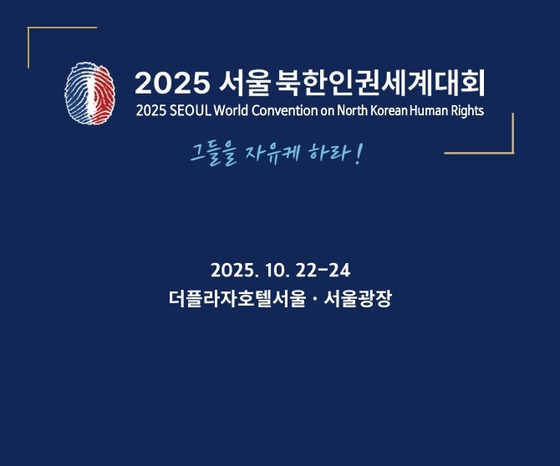
On Wednesday, experts called for international discussions to develop strategies ensuring that North Korea is held accountable for its involvement in the Russia–Ukraine conflict.
During a keynote address at the 2025 World Conference on North Korean Human Rights, organized by the 2025 Seoul North Korean Human Rights World Conference Committee, Song Sang-hyun, the 2nd President of the International Criminal Court (ICC) and Honorary Professor at Seoul National University Law School, argued that North Korea’s reckless military support to Russia gives Ukraine, as a member state, the standing to refer North Korea’s supreme leader to the ICC.
Song emphasized that Kim Jong Un could be held accountable at the ICC for supplying war materials to Russian President Vladimir Putin. He noted that while Russia is the primary aggressor in the Ukraine war, North Korea’s regime, by providing weapons and ammunition, qualifies at least as an accomplice or contributor to the conflict.
He further asserted that if Kim has indeed deployed combat troops, this action could potentially make him a co-perpetrator under Article 25 of the Rome Statute, depending on the evidence gathered.
Song clarified that Kim’s exclusion from ICC investigations for human rights violations isn’t due to the lesser severity of his actions compared to Putin’s crimes. Rather, it is because Putin’s arrest warrant specifically addresses Ukraine war-related crimes, whereas Kim’s human rights violations are too extensive in scope.
He added that under the Rome Statute, either an affected country must file a complaint or the UN Security Council must pass a resolution referring the case to the ICC, neither of which has occurred.
Song referenced the United Nations’ (UN) passage of resolutions 20 years ago referring non-member states Libya and Sudan to the ICC, which resulted in the imprisonment of former Sudanese President Omar al-Bashir. He stated that while a similar referral for Kim would be a significant achievement, Russia and China, as permanent Security Council members, would likely veto such a move. He stressed the importance of mobilizing global public opinion to block these vetoes.
Shin Seok-cheol, representing the North Korean diaspora in the Netherlands, emphasized that North Korean human rights issues are directly aligned with the Netherlands’ international role. He suggested that North Korean defectors and civil society can turn this momentum into concrete actions. Shin proposed that establishing international laws to dismantle political prison camps and creating a special tribunal for North Korean human rights within the ICC are crucial steps toward effective international intervention.
Kwak Young-hoon, president of the UN Korean Association, asserted that human rights issues transcend specific eras or regions. He urged that, just as South Korea achieved remarkable economic growth, North Korean human rights must now become a contemporary agenda to foster development in the North.
Lim Chang-ho, co-representative of the North Korean Human Rights Civil Society Council (NCNKHR), emphasized that the conference’s theme, Let Them Be Free, is not merely a slogan but a declaration of our universal duty to address the suffering of the North Korean people.
The 2025 World Conference on North Korean Human Rights, jointly organized by the NCNKHR and the U.S.-based Human Rights Foundation (HRF), commenced with an opening ceremony at 10:00 a.m. and will continue until Friday at the Plaza Hotel in Seoul’s Jung-gu district and Seoul Plaza.
The conference aims to foster international solidarity among the U.S. Human Rights Foundation and 76 North Korean human rights non-governmental organizations (NGOs) from nine countries, unite the North Korean diaspora, and synthesize 30 years of theoretical and practical efforts to improve North Korean human rights. It will also feature exhibitions, performances, and contests related to North Korean human rights.
Today’s NK INSIDER forum will feature keynote speeches by Kim Kang, former deputy representative at the North Korean Embassy in Russia, and Kim Yumi, Chief Executive Officer (CEO) of Lumina. In a session on artificial intelligence (AI) technology for individual rights, Freedom Tech developer Calvin Kim will discuss applications of Vibe Code.
The event will also include a performance by singer Sunye and remarks from Michael Breen, a columnist and former Washington Times Seoul correspondent known for his extensive writings on both North and South Korea. The evening will conclude with a concert featuring both classical and popular music from North and South Korea, with performances by baritone Samuel Yoon, the Mulmangcho Choir, accordionist Lee Cheol-ok, the vocal ensemble La Classe, and the Lee Cheol-ok AcouMuse Ensemble.