

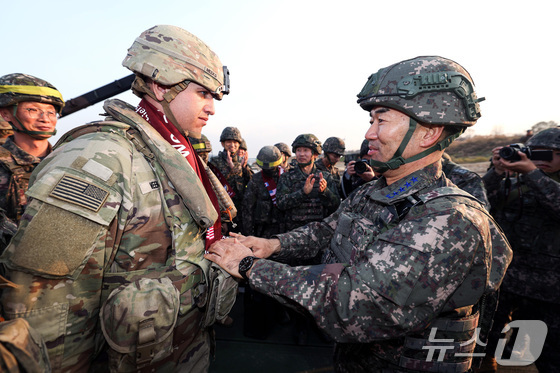
The South Korean government is indicating that scaling back or suspending U.S.-South Korea joint military exercises could serve as a barometer for peace between the Koreas or on the peninsula. While North Korea has used these drills as a pretext for provocations and to justify bolstering its defenses, there are growing concerns that proactively adjusting these exercises could pose security risks, especially given North Korea’s military alignment with Russia and involvement in other conflicts.
Analysts remain divided over whether modifying the joint drills could meaningfully influence North Korea’s behavior, particularly given changes within the North.
President Lee Jae-myung, during his flight to Ankara on Sunday, stated that the joint exercises are North Korea’s most sensitive issue, suggesting that adjustments could either drive change or result from it.
He added that while suspending exercises would be ideal if a solid peace regime were established, prioritizing this action is currently challenging. The government’s cautious stance indicates it won’t proactively propose changes, but it acknowledges considering the exercises as a key element in its North Korea strategy.
Since the Lee administration took office in June, discussions on adjusting the exercises have surfaced repeatedly. During his July 14 confirmation hearing, Unification Minister Jeong Dong Young described the exercises as overly aggressive and suggested the National Security Council should discuss possible changes.
On July 28, shortly after taking office, Minister Jeong told reporters he planned to recommend adjusting the tone of the drills to the president, framing it as a way to encourage dialogue with North Korea.
The debate over modifying exercises to facilitate North Korean dialogue has resurfaced with each progressive administration. In June 2018, the U.S. and South Korea’s decision to suspend drills ahead of the North Korea-U.S. summit seemed to elicit a positive response from Pyongyang, reinforcing the idea that exercise adjustments could be an effective diplomatic tool.
However, the idea that automatically modifying exercises will bring North Korea to the table lacks clear evidence. The 2018 suspension occurred after North Korea had already halted ICBM and nuclear tests and begun dismantling its Punggye-ri test site, suggesting a different causal order.
Even after the 2019 Hanoi summit collapse, South Korea continued to scale back exercises, but North Korea remained disengaged, criticizing the failed U.S. negotiations. North Korea’s 2020 destruction of the inter-Korean liaison office in Kaesong suggests exercise adjustments were more useful in facilitating negotiations than directly influencing North Korean behavior.
Notably, North Korea’s external strategy has dramatically shifted in recent years. Since 2023, it has strengthened ties with Russia, providing support in Ukraine and securing not only potential economic benefits but also enhanced military capabilities and China’s diplomatic backing. This marks a major shift from seven years ago, when Pyongyang had little more than Beijing’s political cover during denuclearization talks with the U.S.
In this context, viewing exercise adjustments as a means to incentivize dialogue could seriously jeopardize South Korean security. North Korea’s recent announcement of plans to build a blue-water navy and potentially conduct joint drills with Russia’s Far East Fleet underscores this risk.
Professor Park Won Gon of Ewha Womans University cautions that any reductions in exercise must be coupled with strengthened U.S. extended deterrence commitments and measures palatable to the South Korean public. Unilateral adjustments without these safeguards could pose significant security and political challenges for South Korea.

North Korea’s perception of the joint exercises also appears to have evolved. Pyongyang previously denounced them as invasion rehearsals and insisted their suspension was essential for peace on the peninsula.
While some saw this as fear of forced regime change, others believed it stemmed from an internal logic compelling responses to exercises—these reactions aimed to manage dissent and foster anti-U.S./South Korea sentiment to bolster regime cohesion.
Analysts have long suggested North Korea wanted exercises halted due to the strain of mobilizing resources for provocative responses.
Recent assessments indicate that under Kim Jong Un, with nuclear capabilities at unprecedented levels, North Korea’s view of the exercises has shifted. The notion of exercises as invasion preparation now seems far-fetched to them, reducing motivation for aggressive responses.
Professor Kim Dong Yeop from the University of North Korean Studies argues that while North Korea sought a strategic exit in 2018, by 2025, it’s in a more comfortable position, expanding its strategic space. Cooperation with China and Russia now provides strategic support, sanctions are weakening, and global attention is divided. This raises questions about the significance of the exercises to North Korea.
Indeed, North Korea codified its nuclear policy in 2022 and enshrined atomic power status in its 2023 constitution. It now demands international recognition of this status as a precondition for dialogue.
In this context, North Korea may now view the exercises as justification for self-defense rather than regime threats. This suggests they might see continued exercise, not its cessation, as an opportunity to enhance military capabilities.
Former Unification Minister Hong Yong Pyo notes that since the 2019 Hanoi summit failure, North Korea has focused on nuclear development, redefined inter-Korean relations as those between two separate states, and shown no interest in dialogue. Given this, adjusting exercises alone is unlikely to bring North Korea back to the negotiating table under current conditions.