

Here’s the converted version of [translateContent] with numerical and financial data adjusted based on [originContent]:
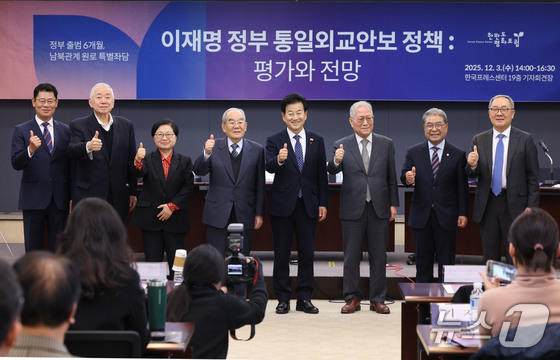
Progressive veterans of inter-Korean relations have collectively voiced concerns about the Lee Jae Myung administration’s END (Exchange, Normalization, Denuclearization) Initiative. They suggest it could be misinterpreted by North Korea or third parties as a call for the end of the North Korean regime, emphasizing the need for a review.
Moon Chung-in, a distinguished professor at Yonsei University, highlighted these issues during a special discussion titled, Six Months into the Government: Evaluation and Prospects of the Lee Jae-myung Administration’s Unification, Diplomacy, and Security Policy. The event took place on the 19th floor of the Korea Press Center. Moon pointed out significant contradictions between the administration’s North Korea policy and its messaging, specifically referencing the END Initiative.
Moon shared that when he explained the END Initiative to European experts, many drew parallels to the early 1990s North Korea Endism. They interpreted South Korea’s plans for exchange, cooperation, and normalization followed by denuclearization as a veiled intention to ultimately dismantle the North Korean regime. He argued that while END signifies the conclusion of hostile relations for us, North Korea or third parties might perceive it as the end of the North Korean regime. The government needs to approach this more cautiously.
He emphasized the need to view North Korea realistically and acknowledge the disconnect between President Lee’s intention to ease tensions and build trust, and the message being conveyed. Moon stressed that this needs to be adjusted.
Former Unification Minister Jeong Se-hyun concurred, stating that the term END can only be interpreted by North Korea as it will finish off North Korea. Such language is unnecessary.
Jeong also underscored the importance of swiftly implementing President Lee’s call for the proactive and phased restoration of the September 19 military agreement, as mentioned in his August 15 Liberation Day speech.
He remarked that in a presidential system, every word from the top policy-maker is policy. Jeong pointed out that actions have not followed the President’s statements and urged his aides to research and implement strategies to restore the September 19 military agreement.
Lee Jae-jung, another former Unification Minister, noted that the President had made restoring the September 19 military agreement his top priority. This was the most realistic task at hand.
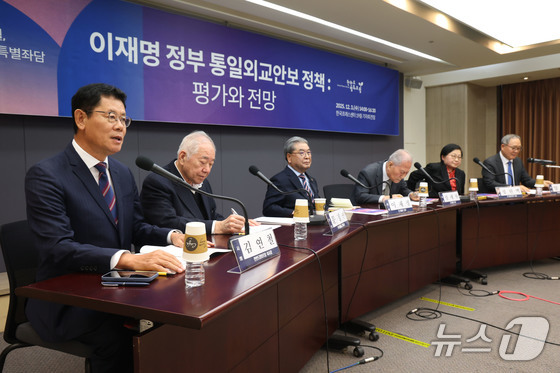
Jeong Suggested That It Needs to Return to the Previous NSC Structure, While Moon Added That, During the Roh Moo-hyun Administration, the NSC Chair was the Unification Minister
The veterans also criticized the current structure of the National Security Council (NSC).
Former Minister Jeong argued that the Yoon Suk Yeol administration had solidified the NSC structure due to personnel issues, creating a system that allowed the security chief to exert control. He stated that it should revert to the previous NSC structure. Jeong deemed it inappropriate for vice-ministerial level officials from the Unification Ministry, Foreign Ministry, and National Intelligence Service to have voting power under the security chief in the current NSC.
Professor Moon noted that during the Roh Moo-hyun administration, the NSC chair was the Unification Minister, with Chung Dong-young holding that position at the time. He added that President Roh’s commitment to inter-Korean relations was clear; he prioritized them and viewed the U.S.-Korea relationship as interconnected.
Former Unification Minister Kim Yeon-chul emphasized the need for alignment across unification, diplomacy, defense, and intelligence sectors to effectively address complex issues during challenging times. He stressed the importance of improving the NSC’s functions and roles.
Professor Moon also argued that the government must clarify its diplomatic priorities. He observed that President Lee’s rhetoric clearly focuses on peace on the Korean Peninsula and improving inter-Korean relations, but in practice, the U.S.-Korea relationship and alliance take precedence. Moon suggested this discrepancy might be due to messaging aimed at the domestic audience, but insisted on the need for consistent priorities.
Participants suggested that temporary tactics like adjusting U.S.-South Korea joint exercises or suspending the deployment of U.S. strategic assets would no longer be effective in bringing North Korea to the negotiating table.
Professor Moon proposed that halting U.S.-South Korea joint military exercises alone would not resolve North Korea’s hostile two-state theory. He explained that ultimately, the Constitution’s Article 3 (territorial clause) and Article 4 (establishment of a free democratic unification policy) are at stake. Moon argued that advocating for a two-state system essentially calls for exchange and cooperation based on international law and the United Nations (UN) Charter.
He added that the essence of international law and the UN Charter is mutual respect for territory and sovereignty, with no interference in internal affairs. Moon predicted that discussions on amending Article 3 of the Constitution would prompt movement from North Korea, expressing skepticism about their response to previous tactical maneuvers.
To elicit North Korea’s cooperation, some suggested that the government should officially apologize for the North Korean provocation-inducing incidents that occurred during the Yoon Suk Yeol administration.
Yang Moo-jin, a distinguished professor at the University of North Korean Studies, referenced past instances where North Korea apologized to the South, such as the Kim Shin-jo and Yeonpyeong Island shelling incidents. He advised that if a court ruling related to foreign exchange crimes arises in a state of insurrection, it may need to express regret to the North.
Unification Minister Chung Dong-young stated in his congratulatory speech that the current inter-Korean relationship does not align with South Korea’s democracy, status, and national dignity. He urged that he hopes it can harness the great strength of our people to open a new era of peace on the Korean Peninsula under Lee’s administration.