

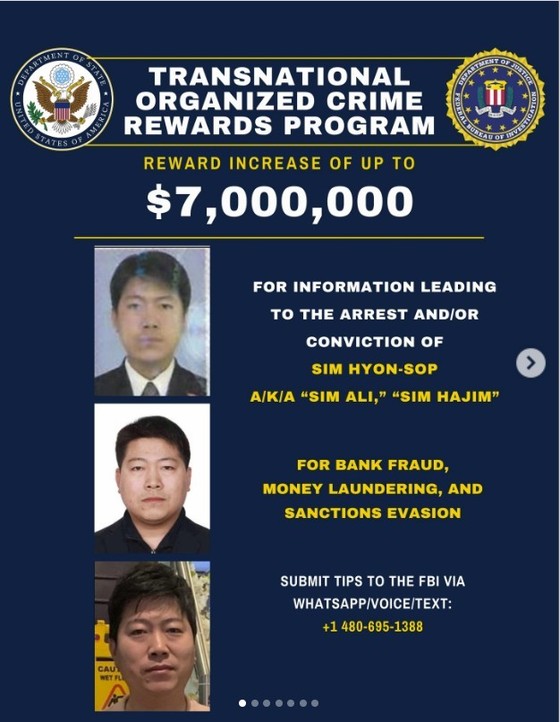
The Wall Street Journal (WSJ) has shed light on the clandestine operations of North Korean banker Shim Hyun Seop, identifying him as a key figure in Kim Jong Un’s shadow financing network.
According to the WSJ report published on Wednesday, Shim used a complex web of shell companies to gain access to the core of the U.S. financial system, effectively circumventing international sanctions.
The WSJ revealed that Shim’s activities have extended into the daily economic lives of American citizens. A prime example is a $216,000 payment made by a California-based cryptocurrency developer to a freelance developer in Singapore.
Investigators found that the funds moved through multiple digital wallets before ultimately reaching accounts controlled by Shim. In effect, money originating from a U.S. company was laundered to help finance North Korea’s weapons programs.
The WSJ cited a recent analysis by cryptocurrency research firm TRM Labs, which detected approximately $67,000 in cryptocurrency from Shim’s wallet being transferred to a wallet linked to Iran’s Islamic Revolutionary Guard Corps (IRGC).
The WSJ explained that this suggests North Korea is utilizing cryptocurrency to settle payments or exchange capital with other sanctioned nations.
Shim evaded detection by the U.S. financial network through his intricate web of shell companies. Major U.S. banks, including Citibank, JP Morgan, and Wells Fargo, unwittingly processed at least 310 transactions totaling about $74 million on North Korea’s behalf.
An indictment cited by the WSJ revealed that Shim used these laundered dollars to purchase communication equipment and Russian helicopters destined for Pyongyang. He even paid over $800,000 in $100 bills to acquire tobacco leaves for producing counterfeit Marlboro cigarettes, a key source of foreign currency for North Korea.
Although detailed personal information about Shim remains limited, the U.S. Department of Justice has reported that the 42-year-old stands 6 ft 1 in (185 cm), significantly taller than the average height of North Korean men, 5 ft 4 in (163 cm).
Ryu Hyun Woo, a former North Korean deputy ambassador to Kuwait who defected to South Korea in 2019, suggested that Shim likely studied English and Chinese at a prestigious university in Pyongyang. Ryu claimed to have met Shim more than ten times.
According to Ryu, Shim was deployed to the Middle East representing an affiliate of North Korea’s state-owned Foreign Trade Bank. Ryu described Shim as the most adept and resourceful money launderer in the Arab region, noting that he drove a Toyota Land Cruiser.
The WSJ reported that Shim had been living and operating in Dubai, UAE, with his wife and daughter since 2016. Although the UAE revoked his residency visa in 2019 due to UN sanctions, he didn’t depart until 2022, citing COVID-19 border closures. He is believed to have relocated to Dandong, China, afterward.
Despite being added to a U.S. Treasury sanctions list in 2023 and the Federal Bureau of Investigation (FBI) offering a $7 million reward for information leading to his capture, Chinese authorities have reportedly declined to cooperate, citing opposition to U.S. unilateral sanctions, according to the WSJ.
The WSJ emphasized that as long as dozens of North Korean bankers like Shim continue to operate abroad, the international community’s stringent economic sanctions against North Korea will inevitably face significant breaches.