

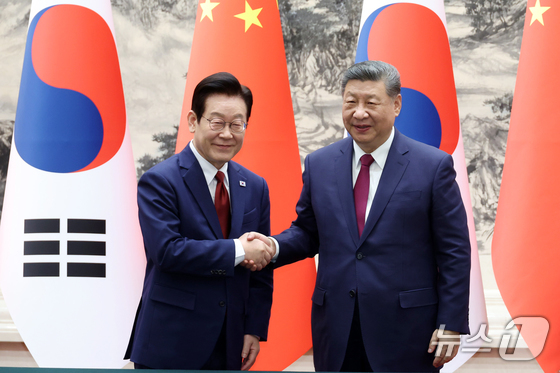
President Lee Jae Myung’s inaugural diplomatic engagement of the new year with Chinese President Xi Jinping yielded significant progress in economic and industrial cooperation.
While both nations agreed to continue discussions on the contentious West Sea structures and the potential lifting of restrictions on Korean cultural imports, they made positive strides in forming a mutual understanding.
More sensitive topics, including South Korea’s pursuit of nuclear-powered submarines, peace on the Korean Peninsula, and the resumption of dialogue with North Korea, saw the exchange of fundamental positions, with in-depth discussions deferred to future meetings.
90-Minute Summit Ran Past the Scheduled Time, A State Banquet Followed… A Thawing Mood in Economic and Industrial Cooperation
On Monday, President Lee and President Xi embarked on the year’s first diplomatic agenda, starting with an official welcome ceremony, followed by the summit, memorandum of understanding (MOU) signings, and a state dinner. The leaders agreed to deepen the strategic partnership between South Korea and China, with a particular focus on expanding economic and industrial cooperation.
During their extended talks, the leaders covered a wide range of bilateral issues. This productive dialogue resulted in the signing of 14 MOUs and a ceremony for the donation of a Qing Dynasty scholar statue. Additionally, private sector businesses from both countries are set to sign 32 MOUs during an upcoming business forum.
The two nations aim to bolster practical cooperation across diverse economic and industrial sectors, including manufacturing, food, fashion, tourism, entertainment, gaming, cultural content, petrochemicals, energy, finance, electric vehicles, semiconductors, displays, secondary batteries, and information and communications technology.
South Korea and China agreed to transition from their traditional division of labor – where South Korea supplied intermediate goods and China exported finished products – to a more balanced partnership. They plan to explore new collaborative models that leverage their respective strengths for joint ventures in third countries.
The leaders also committed to actively collaborating on extending the currency swap agreement between their central banks and promoting the internationalization of the KRW and CNY through enhanced financial institution networks.
Policy Chief Kim Yong-beom reported that President Lee emphasized the value of good neighbors, stating that a good neighbor is worth more than gold. It should seek friends nearby rather than far away. Kim added that he sensed China’s willingness to offer necessary considerations to alleviate South Korea’s economic concerns.
Potential Breakthrough on Korean Wave Restrictions; Practical Talks Begin on West Sea Structures
The summit appears to have uncovered potential solutions to the sensitive issues of Korean cultural import restrictions and West Sea structures that have long been points of contention between the two countries.
Blue House spokesperson Kang Yu-jeong stated that both sides agreed to gradually expand cultural and content exchanges in mutually acceptable areas, and to advance discussions on specific details.
The leaders’ shared understanding of the need to expand cultural and content exchanges has sparked speculation about a possible easing of restrictions on Korean cultural imports. However, analysts caution that the emphasis on mutually acceptable areas and gradual expansion suggests a measured approach rather than an immediate, comprehensive lifting of restrictions.
National Security Office Chief Wi Sung-lac noted that China still doesn’t officially acknowledge the existence of restrictions on Korean cultural imports. He added that during the talks, there was even a lighthearted comment suggesting we needn’t debate whether these restrictions exist or not. It’s hard to predict how this situation will evolve, but it’ll approach it step-by-step through practical negotiations.
While no immediate solution was reached regarding the West Sea structures, both sides demonstrated a proactive stance in seeking resolutions.
Chief Wi stated that it shares the recognition that transforming the West Sea into a zone of peace and prosperity is crucial for the stable, long-term development of South Korea-China relations. It has agreed to work towards holding an official vice-ministerial level meeting on maritime economic planning by 2026.
He also mentioned that it urged for maintaining order in the West Sea regarding illegal fishing and will continue to communicate on this issue.
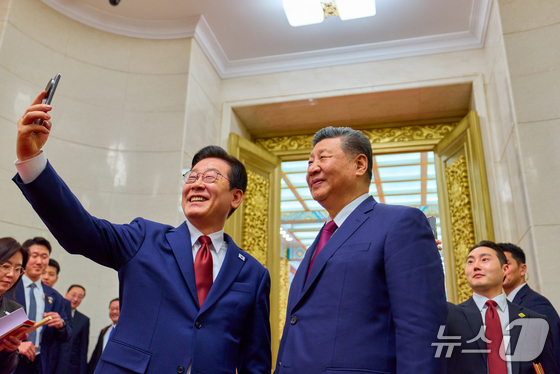
Exploring Peace on the Korean Peninsula; Bridging Gaps on Nuclear Submarines and U.S.-China-Japan Relations
While both countries aligned on the overall direction for peace efforts on the Korean Peninsula, they acknowledged their differing positions, leading to a cautious exploration of potential solutions.
Chief Wi reaffirmed that stability on the Korean Peninsula serves both nations’ interests and confirmed China’s willingness to play a constructive role. He stated that both countries recognized the importance of resuming dialogue with North Korea and will continue to seek innovative approaches to ease tensions and build peace in the region.
South Korea actively worked to address China’s concerns regarding its pursuit of nuclear submarines. Given North Korea’s ongoing efforts to develop nuclear-armed submarines, South Korea emphasized the defensive nature of its initiative.
While China did not offer a clear response to South Korea’s explanations, it reportedly maintained a cautious stance during the summit, refraining from directly challenging the issue.
Chief Wi stated that it provided a detailed explanation of its position to China, and no significant issues were raised. He added that discussions on uranium enrichment and reprocessing proceeded without major concerns.
Amid escalating tensions between China and Japan, President Xi made pointed remarks during the summit, urging a firm stance on the right side of history and calling for accurate strategic choices – comments widely interpreted as criticism of Japan.
The leaders also reportedly exchanged views on rapidly evolving global issues, including recent U.S. military actions against Venezuela, a Chinese ally.
Chief Wi noted that it discussed regional and major international situations and exchanged the positions. While there may not be complete agreement on all points, the dialogue was constructive rather than confrontational, and mutual understanding was evident.
On issues surrounding U.S.-North Korea-Japan relations and the broader international situation, President Lee expressed South Korea’s fundamental stance on alliance-building and establishing a peace regime, while President Xi articulated China’s position. The leaders acknowledged some differences in their diplomatic circumstances while maintaining a respectful dialogue.