

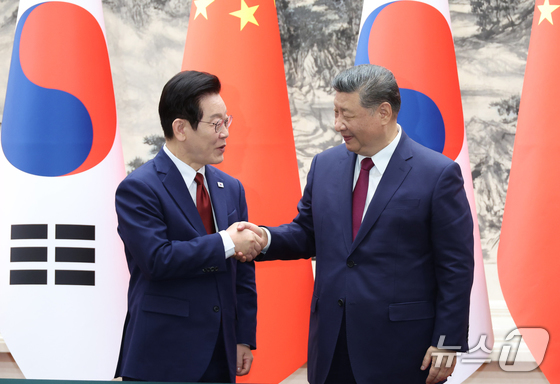
Analysts on Tuesday suggested that the absence of denuclearization discussions during the summit between President Lee Jae Myung and Chinese President Xi Jinping was a deliberate choice, considering the paradoxical reality of the situation. Both leaders reportedly avoided mentioning denuclearization, given North Korea’s increasing hostility towards denuclearization talks.
In a report titled “Strategic Implications and Follow-Up Tasks of the Presidential State Visit to China,” Kim Sung Bae, head of the National Security Strategy Institute, along with Yoo Hyun Jung, director of the China Research Center, and Lee Ji Sun, director of the Peace Development Cooperation Center, highlighted that the Korean and Chinese leaders sidestepped denuclearization talks. They noted the irony that emphasizing denuclearization seems to push it further away.
Kim argued that with North Korea’s firm rejection of the denuclearization agenda, the only viable options are unconditional dialogue to ease tensions on the Korean Peninsula or the end of the state of war on the Korean Peninsula, as mentioned by President Trump during the Korea-U.S. summit in Gyeongju. He believes these issues were likely discussed in depth during the Korea-China summit.
With speculation about a potential North Korea-U.S. summit surrounding President Donald Trump’s planned China visit in April, Kim noted that the Korea-China summit represents a proactive approach to possible rapid changes in the situation on the Korean Peninsula. He cautioned that reacting to the Korean Peninsula situation only as Trump’s visit nears could be too late, risking South Korea’s role as a key player in peninsula diplomacy.
The report also characterized South Korea and China as having the most aligned positions on Korean Peninsula issues. This alignment stems from similarities between the Lee administration’s “E·N·D (Exchange, Normalization of Relations, Denuclearization) Initiative” and China’s “dual-track approach.” Both strategies prioritize unconditional dialogue and peace regime discussions over a denuclearization-first stance.
The report noted that the Korea-China summit, occurring amid escalating China-Japan tensions following Japanese Prime Minister Sanae Takaichi’s comments on potential Taiwan intervention, has created an opportunity for South Korea to act as a regional balancer.
Kim said the Korea–China summit likely included China’s response to Prime Minister Takaichi’s remarks, adding that Japan’s perspective will become clearer during President Lee’s upcoming visit. He also argued that President Lee’s decision to visit China before Japan was a diplomatically astute strategic move.