

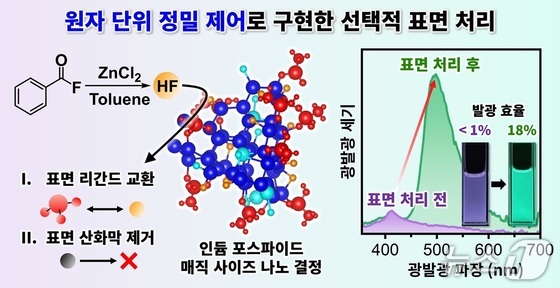
On Wednesday, the Korea Advanced Institute of Science and Technology (KAIST) announced a breakthrough in semiconductor technology. A research team led by Professor Cho Him-chan from the Department of Materials Science and Engineering has developed a novel technique to control the surface of indium phosphide (InP) magic size nanocrystals at the atomic level.
Magic size nanocrystals are ultra-small semiconductor particles composed of just dozens of atoms. These particles are unique because they all share identical size and structure, theoretically allowing them to emit extremely pure light. However, their tiny size – just 1 to 2 nanometers – presents a significant challenge. Even minor surface defects can dramatically reduce light output, limiting their practical applications.
Until now, light efficiency rates for these nanocrystals have struggled to reach even 1%. Previous attempts to address this issue involved using hydrofluoric acid (HF), a potent chemical, to etch the surface. However, this aggressive approach often resulted in damage to the semiconductor itself.
Professor Cho’s team tackled this problem by developing a precision etching strategy. Instead of applying a harsh chemical treatment all at once, they devised a method that allows chemical reactions to occur gradually and in a controlled manner. This innovative approach successfully removed only the problematic surface areas that were hindering light emission while preserving the overall structure of the semiconductor.
During the defect removal process, fluoride generated from the reaction combines with zinc components in the etching solution. This forms zinc chloride, which creates a stable protective coating on the exposed surface of the nanocrystals.
By applying this groundbreaking technology, the research team boosted the light efficiency of the semiconductor from less than 1% to an impressive 18.1%. The team reports that this achievement represents the highest level of performance to date for indium phosphide-based ultra-small semiconductors.
The implications of this research extend far beyond just brighter semiconductors. Experts anticipate that this technology could find applications in a wide range of cutting-edge fields, including next-generation displays, quantum communication, and infrared sensors.
Reflecting on the significance of their work, Professor Cho stated that this research isn’t just about creating a brighter semiconductor. It demonstrates the critical importance of manipulating surfaces at the atomic level to achieve desired performance in nanomaterials.
The study was a collaborative effort, with KAIST doctoral student Joo Chang-hyun and integrated master’s and doctoral student Yoon Seok-beom serving as co-first authors. Professor Ivan Infante from the Basque Center for Materials, Applications, and Nanostructures in Spain contributed as a co-corresponding author. The groundbreaking findings have been published online in the prestigious Journal of the American Chemical Society (JACS).