

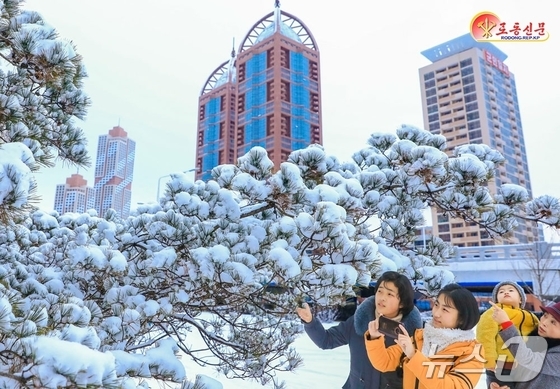
On Tuesday, traditionally considered the coldest day of the year known as Daehan (大寒), a severe cold snap hit North Korea, prompting authorities to issue strong wind and cold weather advisories across various regions.
The Rodong Sinmun, the official newspaper of the ruling Workers’ Party, cited the country’s Hydrometeorological Administration (equivalent to the U.S. National Weather Service) in reporting that strong wind advisories were issued for several west coast areas, southern inland regions, North and South Hamgyong provinces, Yanggang Province, and Rason City from Monday to Tuesday. Cold weather advisories were also issued for most of the country from Tuesday to Saturday.
The newspaper reported that since January 19, the country has been under the influence of a cold continental high-pressure system. Strong winds of 10-15 m/s (about 22-34 mph) were expected in west coast areas, including Jangpung, Dancheon, Kyongwon, and Baegam, as well as in southern inland regions, North and South Hamgyong provinces, Yanggang Province, and Rason City. Some areas, including Yongyon and Mount Paektu, were anticipated to experience gusts of 15-20 m/s (about 34-45 mph).
Temperatures have plummeted since the previous day, with nationwide average temperatures expected to drop 4-6 degrees Celsius (about 7-11 degrees Fahrenheit) below the normal range of -7.4 to -7.3 degrees Celsius (about 18.7 to 18.9 degrees Fahrenheit) from Tuesday to Saturday, resulting in extremely cold conditions. On Wednesday, morning lows are predicted to reach between -38 and -34 degrees Celsius (about -36.4 to -29.2 degrees Fahrenheit) at Paektu Mountain, -33 to -20 degrees Celsius (about -27.4 to -4 degrees Fahrenheit) in most northern areas, and -19 to -10 degrees Celsius (about -2.2 to 14 degrees Fahrenheit) in other regions.
The newspaper also forecasted that the capital, Pyongyang, would experience morning lows around -16 degrees Celsius (about 3.2 degrees Fahrenheit) and daytime highs of about -9 degrees Celsius (about 15.8 degrees Fahrenheit).
The Rodong Sinmun emphasized that citizens should take special precautions to protect their health, and all sectors of the national economy must implement thorough measures to prevent damage from strong winds and severe cold.
Meanwhile, in South Korea, a cold wave advisory has been in effect for most regions since the previous day, excluding the east coast, South Jeolla and South Gyeongsang provinces, and Jeju Island, due to the influx of cold air from the north.