

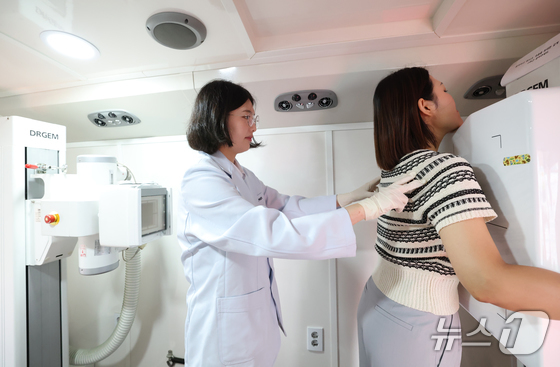
Recent statistics show prostate cancer as the most prevalent cancer among men in South Korea, while breast cancer tops the list for women. This shift in cancer patterns by gender, with prostate cancer overtaking lung cancer in men, is attributed to an aging population and lifestyle changes.
According to the 2023 National Cancer Registration Statistics released on January 21 by the Ministry of Health and Welfare and the Central Cancer Registry, 288,613 new cancer cases were diagnosed last year, a 2.5% increase (7,296 cases) from the previous year. Of these, 151,126 were men and 137,487 were women.
The lifetime risk of developing cancer remains high for South Koreans. Assuming current cancer incidence rates persist, the Central Cancer Registry estimates that approximately one in two men (44.6%) and one in three women (38.2%) will be diagnosed with cancer during their lifetime.
Breaking down the data by gender, prostate cancer led in men with 22,640 cases, marking its first appearance as the most common male cancer since record-keeping began in 1999. Prostate cancer cases increased by 9.9% (2,034 cases) from the previous year, surpassing lung cancer (21,846 cases). Following these were stomach cancer (19,295 cases), colorectal cancer (19,156 cases), and liver cancer (10,875 cases).
For women, breast cancer remained the most common, with 29,715 cases. This continues its multi-year trend as the leading female cancer, followed by thyroid cancer (26,114 cases), colorectal cancer (13,454 cases), lung cancer (11,107 cases), and stomach cancer (9,648 cases).
The rise of prostate cancer to the top spot among male cancers is largely attributed to the aging population. In 2023, patients aged 65 and older accounted for 50.4% of new cancer cases, totaling 145,452. Prostate cancer, typically associated with aging, was most prevalent among men over 65.
Interestingly, despite lower smoking rates among women, lung cancer incidence remains high in older female age groups. Dr. Yang Han-gwang, director of the National Cancer Center, noted that female lung cancer often stems from factors beyond smoking and includes types like adenocarcinoma, which generally respond well to treatment.
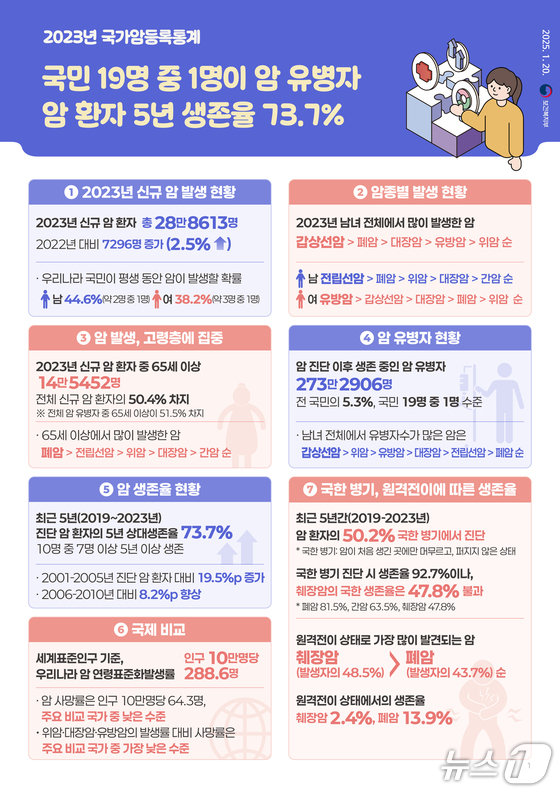
Another significant finding is the overall improvement in cancer survival rates. The five-year relative survival rate for patients diagnosed in the past five years (2019-2023) reached 73.7%, a substantial increase of 19.5 percentage points compared to those diagnosed between 2001 and 2005 (54.2%). This translates to seven out of ten cancer patients now surviving five years or longer.
Survival rates vary considerably by cancer type. Prostate and breast cancers show high five-year relative survival rates at 96.9% and 94.7%, respectively. In contrast, lung cancer (42.5%), liver cancer (40.4%), and pancreatic cancer (17.0%) continue to have much lower survival rates, highlighting persistent disparities across cancer types.
South Korea’s cancer management efforts stand out in international comparisons. Adjusted for the world standard population, South Korea’s 2023 cancer incidence rate of 288.6 per 100,000 is comparable to other major countries. However, its cancer mortality rate of 64.3 per 100,000 is lower than both Japan (78.6) and the U.S. (82.3). Notably, South Korea achieved the lowest mortality-to-incidence ratios among major countries for stomach, colorectal, and breast cancers.
The number of cancer survivors is rapidly increasing due to rising cancer rates and improved survival. As of January 1, 2024, there were 2,732,906 cancer survivors in South Korea, representing 5.3% of the total population. This means one in every 19 citizens is either currently undergoing cancer treatment or has survived cancer.
The government is shifting its approach to view cancer as a condition requiring ongoing management post-treatment. Jung Dong-kyu, director of Public Health Policy at the Ministry of Health and Welfare, stated that with advances in early detection and treatment, more people are living longer with cancer. It is developing a comprehensive cancer management policy that considers both the severity of cancer and post-treatment conditions.
Director Yang added that in response to the growing number of cancer survivors and the increase in age-related cancers, it will systematically implement national cancer management initiatives that include support for cancer survivors.