

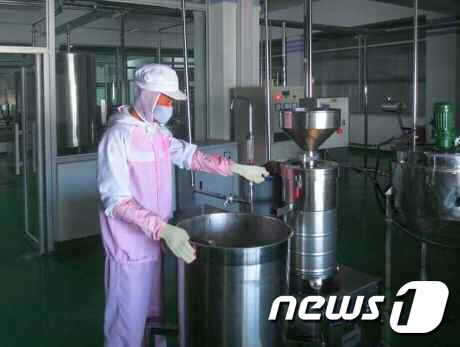
In September last year, North Korean liquor entered South Korea for the first time in about five and a half years. The beverages, Goryeo Doenjang Liquor and Bog Bilberry Brandy, arrived via China and have been held at Incheon Customs for four months, awaiting official entry. The delay is due to the requirement for documentation from North Korea.
On January 16, the Ministry of Unification announced proposed amendments to the Enforcement Decree of the Inter-Korean Exchange and Cooperation Act. This decision results from discussions held by the Inter-Korean Trade Related Ministries Task Force, comprising the Ministry of Unification, Ministry of Food and Drug Safety, Korea Customs Service, and National Intelligence Service since November of the previous year.
Furthermore, drafts of regulations on import inspection procedures for North Korean food products and revisions to guidelines on verifying the origin of inter-Korean trade goods are expected to be announced next month. These measures aim to streamline the import process for North Korean goods.
If implemented, these measures could pave the way for wider distribution of North Korea’s popular Taedonggang Beer in South Korea.
Currently, there is no way to obtain the Certificate of Origin issued by North Korea.
During the period when exchanges with North Korea were possible, several now-defunct inter-Korean exchange organizations, such as the National Economic Cooperation Federation and the National Reconciliation Council, facilitated trade. At that time, inter-Korean trade enjoyed duty-free benefits under Article 3 of the Constitution, as it was considered an internal matter.
However, trade was halted after the South Korean government’s May 24 Measures in response to the Cheonan sinking in 2010. In 2016, North Korea’s nuclear and missile tests led to intensified United Nations (UN) sanctions and the closure of the Kaesong Industrial Complex, effectively ending all inter-Korean transactions.
Various documents are necessary for trade with North Korea. Particularly, a Certificate of Origin issued by the National Economic Cooperation Federation has been essential for importing food products.
However, as North Korea now defines its relationship with South Korea as that of two separate nations and has cut off all communication, private importers can no longer obtain this Certificate of Origin. While goods still flow from North Korea to intermediaries in China, bringing them into South Korea has become impossible.
The amendments recently announced by the Ministry of Unification reflect the current inter-Korean situation.
Article 25 of the amendments introduces a new provision requiring applicants to submit documents necessary for registering foreign manufacturing facilities as stipulated in the Enforcement Rule of the Special Act on Imported Food Safety Control when importing food. This rule, overseen by the Ministry of Food and Drug Safety, includes exception provisions due to practical difficulties in obtaining documentation.
In principle, exporters must provide documentation proving that the manufacturing facility operates legally, issued by the government or a public institution with authorization and registration authority in the exporting country. However, some developing countries may lack such documents or be unable to issue them. Additionally, for small-scale manufacturing facilities or agricultural product packaging locations, documentation may be impossible to obtain, allowing for the submission of a Confirmation Form of Registered Information of a Foreign Food Facility instead.
This Confirmation Form includes basic information such as the facility’s name, location, facility details, type of food, application of food safety management systems, representative, and phone number, along with the facility’s official seal or signature.
If exporters cannot submit certification documents from the exporting country’s government, this regulation allows them to provide documents containing information that can trace the foreign manufacturer or verify the food’s safety.
According to the amendments, the Working Council for Verification of Origin, which includes the Ministry of Unification and the Korea Customs Service, will review the reliability of these documents. To address safety concerns, thorough inspections will be conducted for each import of North Korean products, rather than only during initial import or under special circumstances.
Proving Authenticity of North Korean Products Remains Challenging… Critics Call it a Soft Approach Towards North Korea
Article 25 also adds a provision requiring the submission of a transshipment (complex transshipment) certificate for imports passing through a third country.
This provision addresses scenarios where the country of origin (manufacturing country) differs from the exporting country (country of shipment and customs clearance). It involves an official shipping and customs certificate issued by customs authorities rather than a description written by private companies.
Due to current structural barriers, proving the manufacturing origin of North Korean goods is impossible. The additional measures aim to provide more means to determine manufacturing status. Submitting a transshipment certificate allows authorities to assess authenticity through detailed movement records, aiding in administrative control. However, critics argue that such certificates still fall short of conclusively proving the true origin of goods.
The amendment also streamlines the process by requiring importers to submit transshipment certification documents during the import approval application stage, rather than at customs clearance. This change aims to prevent situations where goods, even after receiving approval from the Ministry of Unification, get held up at customs due to import declaration issues, as seen with previous imports of North Korean liquor.
However, critics argue that since the Ministry of Unification leads the import approval review, this could be seen as an excessive measure to advance the government’s North Korea policy and potentially increase the risk of importing counterfeit North Korean goods.
Some observers believe that through this amendment, the government is focused on establishing mechanisms to resume inter-Korean exchanges and implement a conciliatory approach toward North Korea. This perspective suggests that it opens a pathway for money to flow into North Korea. However, there are also speculations that North Korea may demand Chinese intermediaries cease transactions with South Korea.