

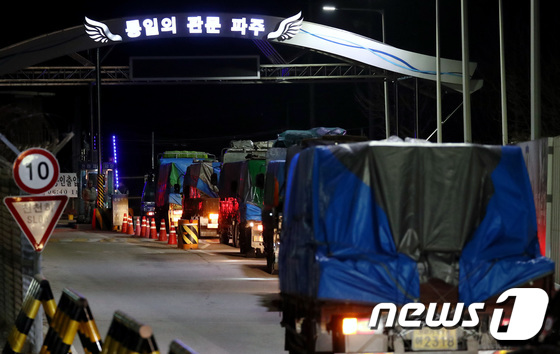
The Ministry of Unification has maintained a formal budget for humanitarian aid to North Korea over the past three years. However, as of Wednesday, it has been revealed that the actual support performance based on policy project criteria stands at zero.
Data from the Ministry of Unification shows that the total amount of humanitarian aid to North Korea executed through the Inter-Korean Cooperation Fund dropped dramatically from 33.7076 billion KRW (approximately 23.6 million USD) in 2022 to 752.06 million KRW (about 527,021 USD) in 2023. The figures for 2024 and 2025 were 763 million KRW (around 534,688 USD) and 756.51 million KRW (roughly 530,140 USD), respectively.
A closer look at the annual breakdown reveals a pattern of quarterly disbursements. In 2023, similar amounts were allocated each quarter: 287.18 million KRW (about 2101,247 USD) in January, 170.21 million KRW (about 119,278 USD) in April, 163.22 million KRW (about 114,406 USD) in July, and 131.43 million KRW (about 92,124 USD) in October. This pattern continued in 2024 with regular distributions of 214.43 million KRW (about 150,301 USD) in January, 190.26 million KRW (about 133,360 USD) in April, 214.40 million KRW (about 150,276 USD) in June, and 143.90 million KRW (about 100,862 USD) in September. The trend persisted in 2025, with allocations of 179.38 million KRW (about 125,730 USD) in January, 196.99 million KRW (about 138,074 USD) in April, 194.89 million KRW (about 136,602 USD) in June, and 185.24 million KRW (about 129,840 USD) in October.
However, it’s important to note that these expenditures were not directly used for aid to North Korea. Instead, they were related to commissioned projects for the Inter-Korean Exchange and Cooperation Support Association, an organization under the Ministry of Unification. A Ministry official clarified that humanitarian aid to North Korea has effectively been suspended.
This suspension is further corroborated by statistics from the North Korea Support Information System. The data shows that the total aid performance from both government and private sectors recorded zero cases for both 2024 and 2025, confirming a complete halt in humanitarian aid to North Korea for three consecutive years.
This execution structure indicates a shift in the nature of humanitarian aid to North Korea. Rather than functioning as an active policy project, it has transitioned to a managed structure that maintains only a minimum level due to fund management constraints. Analysts suggest that the deterioration of inter-Korean relations has made actual policy implementation impossible, leaving only a formal structure for fund management in place.