

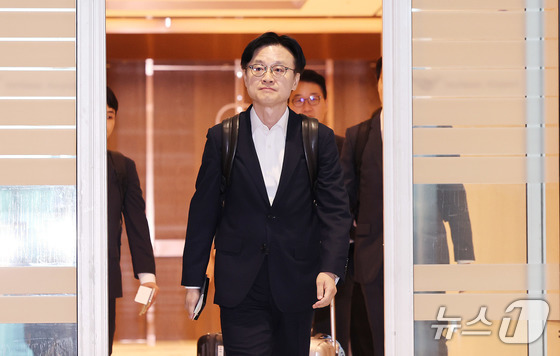
Minister of Trade, Industry and Energy Kim Jung Kwan is set to visit the United States on Thursday to assess the implications of President Donald Trump’s recent remarks on tariff increases and to explore potential solutions through diplomatic channels.
The Ministry of Industry announced on Wednesday that Minister Kim will arrive at Dulles Airport at 9:25 PM Eastern Time.
Upon arrival in the U.S., Minister Kim plans to meet with key officials in Washington, including U.S. Secretary of Commerce Howard Gutman.
These discussions are expected to focus on clarifying South Korea’s position regarding concerns about the implementation of the investment memorandum of understanding (MOU) mentioned by President Trump, as well as outlining future implementation strategies.
On Tuesday, President Trump took to social media to criticize the South Korean National Assembly’s progress on investment-related legislation, threatening to increase tariffs by 25%. The following day, during a press briefing at the White House, he said the United States would work with South Korea to find a solution and signaled a willingness to engage in dialogue.
The U.S. has expressed concerns about delays in the legislative process for South Korea’s “Special Law for Strategic Investment Management” (Special Investment Law). This bill, proposed by the ruling Democratic Party last November, remains stalled in committee due to controversies surrounding the ratification of the trade agreement.
Concurrently, Yeo Han Ku, head of the Trade Negotiation Headquarters, is scheduled to visit Washington, D.C., for talks with U.S. Trade Representative (USTR) Jamieson Greer.
Their meeting is expected to cover not only the implementation of U.S. investments but also address trade barriers, including recent digital regulations raised by the U.S.
In a Fox Business interview on Wednesday, Greer said that last summer the U.S. reached a trade agreement with South Korea and fulfilled its commitment by reducing the tariff rate from 25% to 15% as a show of good faith, but that South Korea had not upheld its end of the bargain.
He further alleged that South Korea had failed to pass the necessary legislation for U.S. investments, introduced new laws related to digital services, and neglected its obligations in the agricultural and industrial sectors.
A Ministry of Industry spokesperson said that while the exact date of Yeo Han Ku’s departure for the U.S. had not been finalized, he was expected to leave in the near future.