

Donald Trump’s erratic statements on tariffs are once again creating uncertainty for South Korea’s export-driven economy. As trade policies seem to swing with political winds and the president’s impulsive decisions, experts are calling for a structural approach to managing the U.S. risk. To reduce dependence on specific countries, diversifying export markets is crucial. In this context, there’s growing support for public discussions on rejoining the Comprehensive and Progressive Agreement for Trans-Pacific Partnership (CPTPP).
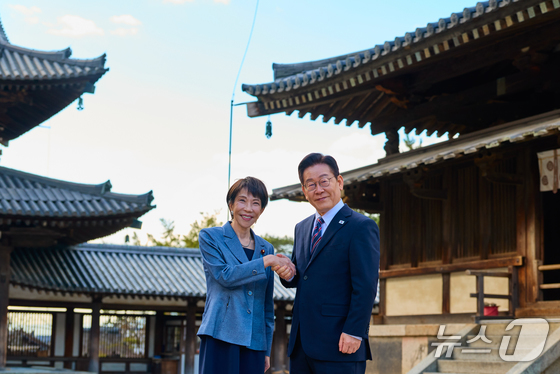
According to trade officials, South Korea and Japan have begun working-level talks about South Korea’s potential re-entry into the CPTPP. This follows a summit between President Lee Jae Myung and Japanese Prime Minister Sanae Takaichi in Japan on January 14, at which the two leaders reportedly agreed to explore cooperation on CPTPP membership.
The South Korean government sees the multilateral, bloc-based trade system as a potential lifeline amid instability in the World Trade Organization (WTO), which has been shaken by the United States’ increasingly protectionist stance. Since the new administration took office, efforts to join the CPTPP have gained momentum.
Last September, Trade Minister Yeo Han Ku attended the Korea-ASEAN Economic Ministers’ Meeting and held bilateral talks with economic ministers from CPTPP members such as Australia, New Zealand, and Indonesia to discuss South Korea’s potential membership.
Unlike previous attempts, Japan, a key gatekeeper for CPTPP membership, has shown a more positive response. The CPTPP requires unanimous approval from existing members for new entrants. South Korea first officially considered joining in 2021 under the Moon Jae In administration, but didn’t proceed with an application, largely due to opposition from domestic agricultural and fisheries sectors and Japan’s stance.
National Security Advisor Kim Sung Han reported that South Korea’s basic approach was discussed favorably during the January 14 Korea-Japan summit briefing.
The CPTPP, a multilateral trade agreement among 12 Pacific Rim countries, including Japan, Australia, Canada, and Singapore, aims to provide broad market access and unified trade norms. If South Korea joins, it could see significantly higher tariff elimination rates and improved access to markets representing about 15% of global GDP.
However, concerns persist. The CPTPP includes agricultural powerhouses like Australia, Canada, and New Zealand, as well as fishing giants like Japan, raising fears that expanded market access could harm domestic industries.
Proponents of membership point to the volatile trade environment, particularly the Trump risk. Last November, the U.S. and South Korea agreed to reduce tariffs on South Korean automobiles from 25% to 15%, with mutual tariffs also set at 15%, contingent on a 350 billion USD investment from South Korea.
However, on Wednesday, President Trump threatened to reinstate the 25% tariff, citing delays in South Korean legislative action not originally included in the agreement.
The government’s main challenge is addressing public concerns about opening agricultural, livestock, and fishery markets.
The Korea Rural Economic Institute reports that CPTPP members’ average tariff elimination rate for agricultural products is 96.3%, far higher than the 72.0% average in South Korea’s existing FTAs. Joining would inevitably raise agricultural market openness, according to industry experts.
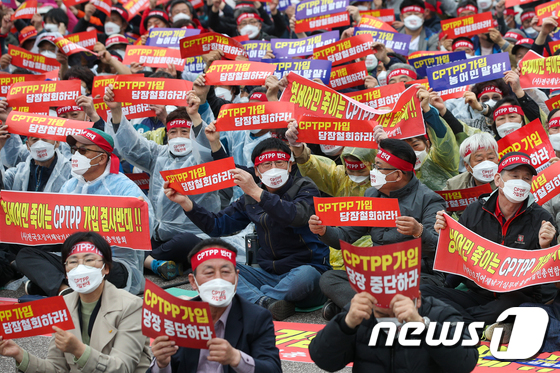
The presence of global livestock powerhouses such as Australia, Canada, New Zealand, and the UK among CPTPP members suggests increased pressure for market access in this sector.
However, there are also strong voices urging swift action to rejoin the CPTPP, seeing it as a necessary response to shifts in the trade environment under the Trump administration.
A recent Korea International Trade Association report, “Free Trade Under Attack: FTA Trends and Implications,” emphasized South Korea’s small domestic market and high dependence on external trade. It suggested that improving existing FTAs might be more effective than pursuing new ones.
Over the past five years, South Korea’s exports to FTA partners grew by an average of 5.1% annually, outpacing both global export growth (4.7%) and exports to non-FTA countries (3.7%). This indicates FTAs have played a stabilizing role in South Korea’s export performance.
The report urges South Korea to quickly implement FTAs already negotiated with the Gulf Cooperation Council (GCC), the UAE, Guatemala, and Ecuador, while also pursuing CPTPP membership, which offers higher levels of liberalization than existing FTAs.
The report also notes that the EU has begun CPTPP membership discussions, suggesting that, amid growing trade uncertainty, joining the CPTPP could help South Korea improve its competitive position relative to rivals such as Japan.
At a recent Korean Press Club discussion, Foreign Minister Park Jin said CPTPP membership was originally created among Pacific nations and noted that the UK had recently joined. He added that even if South Korea faced difficulties in specific industries, it should still join, and asked rhetorically: if Vietnam could do it, what did South Korea have to be afraid of?