The Donald Trump administration has reportedly begun preparations to publish a notice in the Federal Register regarding the potential reinstatement of a 25% tariff on South Korean products, escalating tensions in ongoing negotiations.
As Seoul ramps up diplomatic efforts to sway Washington, trade experts suggest this move is more likely a classic Trump negotiation tactic aimed at expediting the passage of a special investment law rather than a genuine intent to implement tariffs.
On Monday, the Ministry of Trade, Industry, and Energy reported that Yeo Han-koo, South Korea’s chief trade negotiator, continues to engage with U.S. officials in Washington. Yeo is conveying Seoul’s commitment to U.S. investments and outlining specific implementation timelines. Since arriving in the U.S. capital on January 31, Yeo has reportedly met with Trump administration officials and members of Congress.
Despite Dispatching Trade Minister Kim Jung-kwan to the U.S., Efforts to Halt the Tariff Reinstatement Yet to Bear Fruit
Prior to Yeo’s visit, Minister Kim held daily discussions with U.S. Commerce Secretary Howard Lutnick but returned to South Korea without securing a definitive halt to the tariff threat.
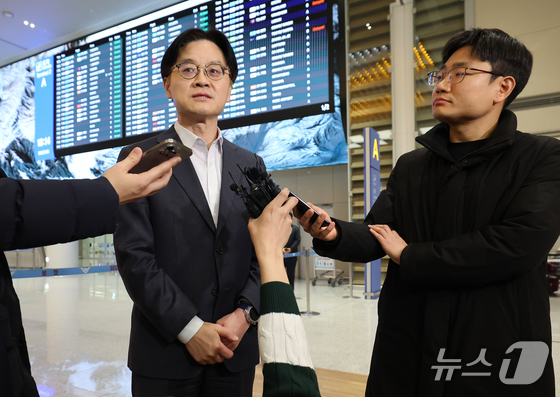
Upon his return to Incheon International Airport on January 31, Minister Kim informed reporters that the U.S. has already initiated steps to publish the tariff increase notice, underscoring the prevailing sentiment in Washington that tariffs could be imposed at any moment. If published in the Federal Register, these measures could be finalized and enacted swiftly, amplifying uncertainty for South Korean exporters.
The South Korean government is working on two fronts: explaining to the National Assembly the urgent need to pass the special investment law, while simultaneously conducting preliminary reviews and discussions on investment implementation. This dual approach aims to prevent tariff negotiations from regressing to square one.
Seoul maintains that it will not jump to conclusions regarding the tariff increase and will closely monitor U.S. actions. A Ministry of Trade official stated that as of now, there’s no confirmed timeline for the notice publication or any specific schedule. Various possibilities remain open in the U.S., and it is continuing the discussions accordingly.
Further consultations between South Korea and the U.S. are being coordinated, including video conferences. The level of these meetings – whether working-level or ministerial – has yet to be determined. The South Korean government plans to focus on diplomatic efforts to minimize uncertainty and prevent industrial disruptions by explaining the investment implementation timeline to the National Assembly.
What are the Real Chances of Tariff Reinstatement? Experts Weigh In on the Pressure Tactics
Trade specialists identify the delay in processing the special investment law as the primary catalyst for the current tariff pressures. While South Korea and the U.S. agreed last year to lower tariffs in exchange for increased U.S. investments, analysts suggest that Washington is likely to maintain pressure until the law is passed and fully implemented.
Han Ah-reum, a researcher at the Korea International Trade Association, noted that while the agreement was to lower tariffs when the law was proposed, the U.S. likely wants to see it passed and implemented. This suggests an intent to maintain leverage even after the initial tariff reduction.
Notably, this issue has bypassed typical diplomatic channels, with President Trump directly mentioning tariff increases on social media. This approach is seen as a quintessential Trump tactic, aimed at maximizing political pressure before formal negotiations begin.
However, few experts believe tariffs will immediately jump to 25%. Given that tariffs aren’t typically adjusted rapidly, some view this as more of a negotiating tactic than an imminent policy change.
Kim Soo-dong, a senior researcher at the Korea Institute for Industrial Economics and Trade, observed that fluctuating tariffs between 15% and 25% within a few months would be logistically challenging for U.S. customs authorities. At this stage, it appears to be more of a pressure tactic than a concrete policy shift.
Kim added that speed is of the essence now. If South Korea clearly outlines its implementation schedule and plans, the U.S. may be less inclined to formalize the tariffs through the Federal Register.”
The approaching U.S. midterm elections add another layer of complexity, potentially influencing Trump’s use of tariffs as a political and diplomatic tool.
Kim remarked that Trump has consistently wielded tariffs as a universal pressure tactic. Similar strategies could be employed not just with South Korea, but also with the European Union (EU) and other nations.
Indeed, President Trump has recently made a habit of threatening tariff increases against various countries before backtracking. Consequently, analysts predict that the tariff issue between South Korea and the U.S. may evolve into a long-term trade risk requiring ongoing management, rather than a short-term crisis.