

The Donald Trump administration, facing a setback in its tariff policy due to the U.S. Supreme Court’s ruling on reciprocal tariffs as illegal, has abruptly implemented a 150-day temporary global 10% tariff system under Section 122 of the Trade Act, effective from 2:00 p.m. on Tuesday (Korean time).
This measure appears to be a stopgap bridge for the Trump administration, buying time before launching a more comprehensive investigation under Section 301 of the Trade Act, which they have signaled as their next major tariff action.
Section 301 is considered a powerful negotiating tool, as it includes a wide range of retaliatory measures beyond tariffs, such as import restrictions. The mere initiation of an investigation can pressure other countries into concessions. Consequently, global trade uncertainty is expected to increase, regardless of whether actual tariffs are imposed.
Defying the Court Ruling: The Section 301 Card Hidden Behind the 150-Day Bridge
After the court ruled that reciprocal tariffs based on the International Emergency Economic Powers Act (IEEPA) were illegal, the U.S. pivoted to imposing global tariffs under Section 122 of the Trade Act.
Section 122 is a temporary provision for addressing urgent situations like trade imbalances. Tariff measures under this section can only be maintained for 150 days, after which congressional approval is required for extension. Thus, Section 122 is widely interpreted as a temporary, transitional measure rather than a structural tariff framework, likely paving the way for subsequent actions such as Section 301.
In fact, U.S. Treasury Secretary Scott Bessent stated in a CNN interview on February 22 that Section 122 is more of a bridge than a permanent measure, suggesting it may no longer be necessary once investigations under Section 301 or similar provisions are completed.
This indicates that the Trump administration plans to establish more sustainable grounds for imposing tariffs during the 150-day grace period.
The alternative being discussed is Section 301 of the Trade Act. This provision allows the President to take a wide range of retaliatory measures, including raising tariffs, withdrawing concessions, and restricting imports, if the U.S. Trade Representative (USTR) determines that a foreign country’s actions are unjustified, unreasonable, or discriminatory.
With its broad discretionary scope allowing various forms of sanctions beyond tariffs, Section 301 has been used to parallel or bypass World Trade Organization (WTO) dispute procedures.
Negotiation Pressure Even with Investigation Launch: The Variable of Speed
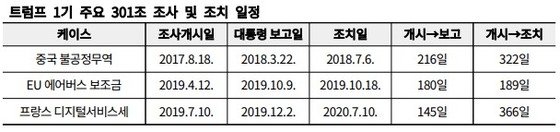
The Trump administration’s first term saw active use of Section 301. While the Obama administration initiated only three Section 301 investigations in eight years, the first Trump administration launched six. These investigations targeted issues such as China’s intellectual property rights and technology transfer practices, European Union (EU) aircraft subsidies, France’s Digital Services Tax (DST), digital taxes in ten countries, and Vietnam’s currency and timber issues.
Historically, Section 301 investigations have typically taken six months to over a year from initiation to presidential report and tariff imposition. The China-focused investigation took over 200 days before reporting to the President, with actual tariffs imposed after more than 300 days. Similar timeframes were seen in the French digital tax and EU aircraft subsidy cases. The investigation into digital taxes in ten countries took about a year to reach a final tariff decision.
Given these precedents, it’s widely believed that completing both the Section 301 investigation and subsequent measures within the 150-day temporary tariff period under Section 122 would be challenging. Section 301 requires time for procedural steps like stakeholder consultations, public hearings, and report preparation.
However, some analysts argue that Section 301 shouldn’t be viewed solely as a timing issue, as the mere initiation of an investigation can exert significant trade pressure, even if actual tariff imposition takes longer.
It’s also noteworthy that the second Trump administration has been accelerating the pace of tariff-related administrative actions compared to the first term. For instance, investigations under Section 232 of the Trade Expansion Act, which assesses national security threats, were completed much faster in the second term. The copper investigation under Section 232 concluded in about 140 days, leading to a 25% tariff imposition, a marked reduction from the 240-270 days taken for steel, aluminum, and auto parts investigations during the first term.
While Sections 232 and 301 differ in legal nature and procedures, the administration’s demonstrated intent to expedite tariff policies suggests that Section 301 investigations might also proceed more rapidly than in the past.
Targeting Digital, Pharmaceutical, and Rice Sectors: Heightened Trade Risks for South Korea
Past examples support the notion that Section 301 investigations can serve as negotiation leverage tools, regardless of whether tariffs are actually imposed.
Currently, only the Section 301 tariffs on China remain in effect. Tariffs related to EU aircraft subsidies, digital taxes, and Vietnam’s currency and timber issues have been either fully suspended or deferred through bilateral and multilateral negotiations. Many assess that the mere initiation of investigations and tariff threats achieved significant trade pressure.
Future investigation targets are also of interest. The USTR has indicated that Section 301 investigations may focus on pharmaceutical pricing practices in major trading partners, discrimination against U.S. tech companies and digital goods/services, digital service taxes, and trade practices related to rice and other agricultural products.
The digital, pharmaceutical, and agricultural sectors are particularly sensitive issues for South Korea, raising concerns about potential trade risks becoming a reality.
Song Young-gwan, a senior researcher at the Korea Development Institute, noted that while Section 301 investigations during Trump’s first term often took about a year to result in action, recent trends suggest investigations could accelerate. He added that while time constraints might limit concrete measures before the U.S. midterm elections later this year, the mere initiation of investigations could serve as a sufficient pressure tactic, likely prolonging trade environment uncertainties.