

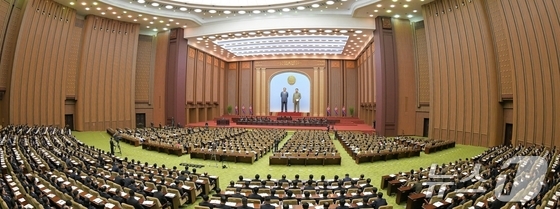
North Korea is set to hold elections for its Supreme People’s Assembly, the equivalent of a national legislature. Following decisions made at the 9th Congress of the Workers’ Party, the regime is expected to appoint a new cabinet and introduce legislation aligning with its two Koreas policy.
According to the March 4 edition of Rodong Sinmun, the Workers’ Party’s official newspaper, the Standing Committee of the Supreme People’s Assembly announced through Decision No. 360 that elections for the 15th term of the assembly will take place on March 15. North Korea’s socialist constitution stipulates a five-year term for assembly members, with elections typically held on the same schedule.
Concurrent with the election announcement, North Korea revealed the composition of the Central Election Commission. Kim Hyung-sik will serve as chairman, with Jeon Kyung-cheol as vice chairman and Ko Gil-sun as secretary general. The commission includes members such as Jang Chang-hyuk, Han Young-guk, Bang Du-seop, Kim Geum-cheol, Ri Myong-guk, Mun Chol, Han Jong-hyuk, Jeon Hyang-sun, Park Hee-cheol, and Jeon Seong-min.
The Supreme People’s Assembly is North Korea’s highest organ for constitutional and legislative matters. While elections ostensibly involve selecting candidates from regional districts, in practice, voters simply approve or reject a single candidate nominated by the Workers’ Party. This process is often viewed as a formality to confirm the party’s predetermined power structure.
At the previous party congress, North Korea deliberated on personnel plans for the next Standing Committee and cabinet. Following this election, immediate appointments for these positions in the 15th Supreme People’s Assembly are anticipated.
The 9th Party Congress saw Choe Ryung Hae, North Korea’s second-highest official, step down from his role as chairman of the Standing Committee. There is significant interest in who will assume this position.
North Korea last elected members for the 14th Supreme People’s Assembly in 2019. While that term was set to end in early 2024, analysts believe the 15th election was postponed to align with the five-year cycle of the party congress.
Yang Moo-jin, a professor at the University of North Korean Studies, noted that the Supreme People’s Assembly elections following the party congress mark the completion of the Kim Jong Un-centered party and state system. This move aims to synchronize terms for Central Committee members and assembly delegates while reinforcing the regime’s centralized leadership.
This election is notable for its unusually brief preparation period. Hong Min, a senior researcher at the Korea Institute for National Unification, observed that there’s only a 12-day gap between the announcement and election day. Previously, a 60-day preparation period was typical for candidate nominations and voter list publications. It’s likely that internal vetting of candidates is already substantially complete.
Experts anticipate that the first session of the 15th Supreme People’s Assembly will focus on potential constitutional amendments and key appointments. Discussions may include formalizing the two hostile states policy, further emphasizing nuclear capabilities, and revising the constitution to solidify Kim Jong Un’s era of leadership.