

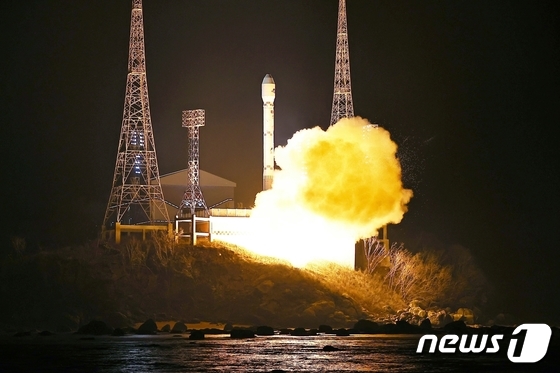
Experts predict North Korea will significantly enhance its space capabilities by deploying multiple surveillance and reconnaissance satellites in low Earth orbit. This development is expected to intensify military and technological competition between North and South Korea in space during the 2030s.
A report released on February 28 by the Korea Institute for Defense Analysis (KIDA) sheds light on this issue. Shin Seung-ki, a research fellow in KIDA’s Nuclear Security Research Division, authored a study titled, Prospects for the Advancement of North Korean Space Threats. In it, he asserts that North Korea harbors strong ambitions to join the ranks of global satellite powers like the U.S., Russia, and China.
According to Shin, North Korea’s short to medium-term space strategy will likely focus on developing surveillance and reconnaissance satellites. The country is currently upgrading its military electro-optical (EO) surveillance satellites and enhancing satellite data analysis capabilities. Following global trends, North Korea may soon develop and mass-deploy microsatellites in low Earth orbit, potentially within a short timeframe.
Shin anticipates that by 2030, space-based competition between the two Koreas will heat up significantly. He projects that North Korea will adopt a high-low mix strategy, combining relatively high-resolution medium and small satellites with low-resolution microsatellites. This approach aims to minimize revisit times over the Korean Peninsula and other areas of strategic interest.
The advancement of North Korea’s satellite technology poses a significant threat. These capabilities could enable efficient control of satellite constellations in conjunction with ground stations, facilitating real-time, wide-area command and control across their armed forces. Additionally, it could support the operation of medium to long-range unmanned aerial vehicles for surveillance and strike missions.
Currently, South Korea maintains a substantial lead in the satellite race between the two nations. The South Korean military recently completed the launch of five military reconnaissance satellites under the 425 Project. Once fully operational, this constellation will enable monitoring of North Korean activities at two-hour intervals through coordinated operations. Furthermore, the South Korean military is pursuing an ambitious project to develop and launch over 20 small satellites and 40 microsatellites by 2030.
In November 2023, North Korea claimed to have successfully launched its first military reconnaissance satellite, Malligyong-1. However, the actual capabilities of this satellite remain unverified by external sources. A subsequent attempt to launch an additional military reconnaissance satellite in 2024 failed, and progress on related projects has since stalled. Despite these setbacks, Kim Jong Un, General Secretary of the Workers’ Party, reaffirmed the country’s commitment to continued reconnaissance satellite development during the 9th Party Congress held on February 20 and 21.
Shin anticipates that North Korea will pursue advancements in launch vehicle technology alongside its satellite program. This could involve improving new liquid-fuel propulsion systems while simultaneously developing solid-fuel alternatives. Long-term projections suggest the possibility of North Korea launching medium to large surveillance, communication, and navigation satellites, potentially deploying them across various orbits, including geostationary.
The analyst acknowledges that North Korea faces significant technical and industrial constraints in independently advancing its space capabilities. To overcome these limitations, Shin believes North Korea is likely to strengthen military and defense cooperation with Russia, seeking to acquire technology, materials, components, equipment, and expertise related to space development.
Shin concludes that, mirroring the regular joint exercises conducted by South Korea and the U.S., North Korea is expected to pursue joint space training, exercises, and operations with Russia. These collaborative efforts would aim to supplement North Korea’s limited space capabilities and continuously enhance its space operational proficiency.