

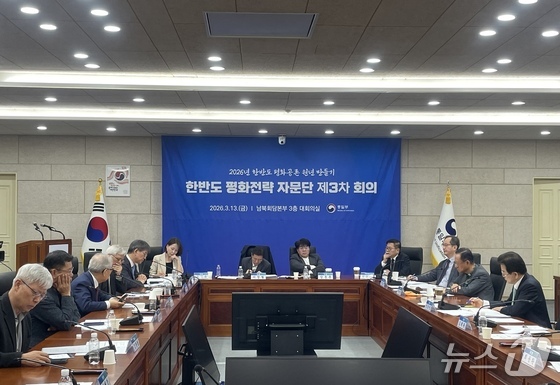
On March 13, former Unification Minister Jeong Se-hyun proposed that the Lee Jae Myung administration should officially declare a South-North confederation as the ultimate goal of its North Korea policy. While the government promotes peaceful coexistence on the Korean Peninsula, Jeong argued that it has not clearly defined the policy’s end point.
Jeong made these remarks during the third meeting of the Korean Peninsula Peace Strategy Advisory Group, chaired by Unification Minister Chung Dong-young, at the South-North Dialogue Headquarters in Seoul.
He explained that despite assurances of not pursuing forced unification and recognizing North Korea’s regime, Pyongyang likely harbors suspicions about Seoul’s true intentions. Jeong emphasized the need to clarify the extent of the peaceful coexistence policy.
Referencing the 1989 ethnic community unification plan proposed during the Roh Tae Woo administration, Jeong stressed that officially announcing a South-North confederation as the final stage of the North Korea policy roadmap could improve inter-Korean relations and prevent North Korea from becoming further estranged.
The ethnic community unification plan outlines a three-stage process: Reconciliation and Cooperation → South-North Confederation → Unified State. This approach aims for gradual unification through trust-building, avoiding military conflict or forced absorption. Jeong believes that establishing a peaceful atmosphere and clearly defining the path toward a confederation could prevent North Korea from misinterpreting Seoul’s intentions.
Minister Chung acknowledged the need to present a framework beyond peaceful coexistence. He noted that the Middle East conflict, though 6,700 km (about 4,163 miles) away, impacts the Korean Peninsula, underscoring that peace is not an abstract concept but directly affects people’s lives.
The meeting also addressed President Donald Trump’s upcoming China visit and the prospects for U.S.-North Korea dialogue.
Professor Lee Hae-jung from Chung-Ang University observed that the Korean Peninsula is not currently a top priority for the U.S. or China, with no immediate prospects for a U.S.-North Korea summit. She urged South Korea to act not only as a facilitator but also as an active peacemaker, especially given the four planned U.S.-China summits this year.
Following North Korea’s recent reinforcement of its two hostile states stance at the 9th Workers’ Party Congress, experts agreed on the need to focus on reducing bilateral hostility.
Dr. Choi Eun-joo of the Sejong Institute suggested temporarily setting aside the two nations concept, arguing that diminished hostility could lead to neighborly coexistence. She noted North Korea’s apparent concern over cultural rather than military absorption, advising the government to consider this when promoting inter-Korean exchanges.
Kim Jeong-seop, a senior researcher at the Sejong Institute, emphasized the importance of arms control in reducing hostility while maintaining deterrence.
Kim interpreted North Korea’s recent statement about pursuing both military and economic power as an indication that they are not solely focused on military strength. He suggested that arms control efforts could effectively limit North Korea’s military expansion.
This third advisory group meeting, following sessions in December and January, marked the first time discussions were made public.