

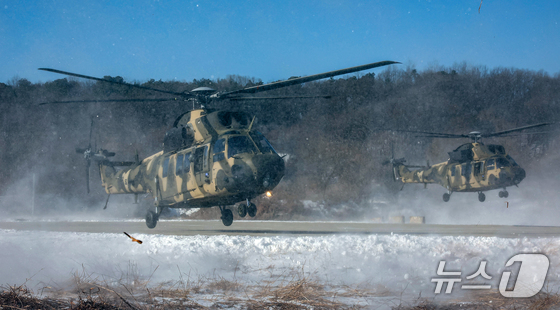
As tensions escalate across the Middle East due to clashes between the U.S. and Iran, leading South Korean defense companies like LIG Nex1, Hanwha Aerospace, Korea Aerospace Industries (KAI), and Hyundai Rotem are gaining prominence. Additionally, small and medium-sized enterprises supplying key components, as well as drone and artificial intelligence (AI) startups, are emerging as new growth drivers in the defense sector.
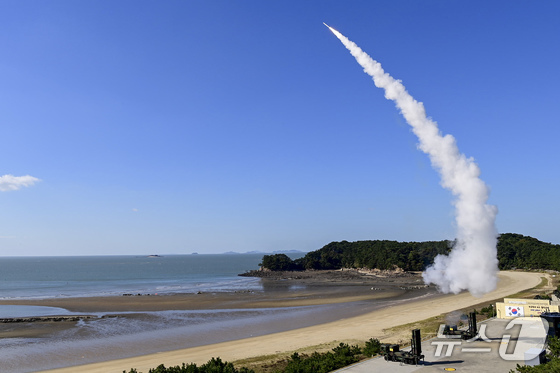
The Cheongung-II (M-SAM2), a medium-range surface-to-air missile system deployed in the United Arab Emirates (UAE), recently demonstrated high interception rates during missile strike scenarios. This success has further bolstered expectations for the expansion of South Korean defense exports.
Expansion of K-Defense Exports Creates Opportunities for Suppliers and Startups
Industry sources reported on Monday that the prolonged military tensions in the Middle East are likely to strengthen the long-term export momentum for South Korean defense products.
Analysts predict this export boom will ripple through South Korea’s defense manufacturing belt, particularly benefiting regions like Sacheon, Changwon, and Geoje. Companies in the aviation and precision machining sectors, along with industrial and military drone startups, are expected to be the primary beneficiaries.
As drones, loitering munitions, and AI-based software weapons emerge as battlefield game-changers, the strategic value of small suppliers providing precision parts, sensors, and algorithms is also increasing.
Collaborative efforts among major defense contractors to nurture their supply chain partners are creating growth opportunities for these smaller enterprises.
Last month, Hanwha Aerospace and KAI launched the Future Aerospace Strategy Committee, agreeing to share partner networks in unmanned systems, advanced engine development, and global space market entry.
They plan to create a joint pool of suppliers from the Changwon, Sacheon, and Geoje regions, offering a comprehensive growth package that includes financial support, equipment investment, and specialized workforce training.
Future Aviation in Sacheon is highlighted as a key beneficiary. Established in 1990, the company has leveraged its 28 years of aircraft parts processing and 24 years of assembly expertise to supply Airbus A320/321 lower wing structures and Boeing B737 tail wing and rear fuselage components to global aircraft manufacturers.
In the military sector, Future Aviation is entrusted with assembling critical structures for various KAI aircraft, including the central fuselage of the KT-1 basic trainer, cockpit doors and engine cowlings of the KUH Surion helicopter, and wing structures for the A-10 attack aircraft.
Private capital is also flowing into the South Korean defense sector.
Investment banks and venture capital firms are establishing dedicated funds targeting companies innovating in defense technologies such as drones, anti-drone systems, AI-based automatic target recognition, and satellite data analysis.
The Defense Acquisition Program Administration announced last December the establishment of a Second Defense Technology Innovation Fund worth 310 billion KRW (approximately 208 million USD). This fund aims to invest in private companies developing advanced technologies in semiconductors, space, AI, robotics, and drones, supporting both new entrants and existing small and medium-sized defense firms.
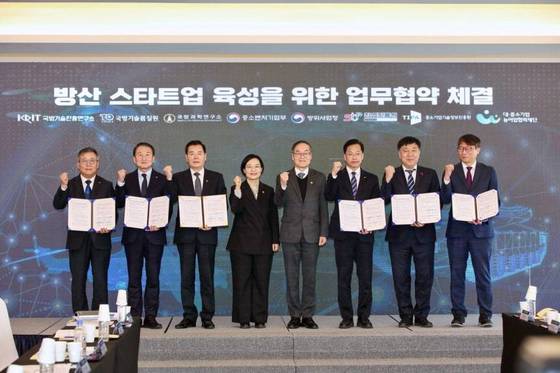
Government’s Startup Challenge Broadens Partnerships with Big Business and the Military
The government has launched a comprehensive Defense Development Promotion Task Force to bolster support for the industry.
The Ministry of Small and Medium-sized Enterprises (SMEs) and Startups and the Defense Acquisition Program Administration have proposed an ambitious plan to nurture 100 defense-focused startups and 30 defense venture companies with annual sales exceeding 100 billion KRW (approximately 67 million USD) by 2030.
This initiative aims to transform the traditional manufacturing and large corporation-focused defense structure into an ecosystem centered on innovative companies specializing in advanced civilian technologies such as drones, AI, robotics, space, and semiconductors.
A key component of this strategy is the Defense Startup Challenge. The government plans to hold about ten challenges annually, expanding opportunities for promising defense startups to collaborate with large corporations and the military. For advanced weapons like drones and AI systems, a new competitive procurement system will allow startups to propose their own weapon systems.
A comprehensive support system will be established around the K-defense Startup Hub, involving organizations such as the Defense Science Research Institute and the Creative Economy Innovation Center. This hub will provide end-to-end assistance for technology transfer, R&D, and mass production/export packages.
An industry insider noted that the ongoing conflict in the Middle East is likely to diversify the defense supply chain, particularly in drone platforms and components for unmanned systems. The ecosystem of small businesses and startups specializing in precision machining, sensors, and software will establish itself as a new growth pillar for South Korea’s defense industry.