

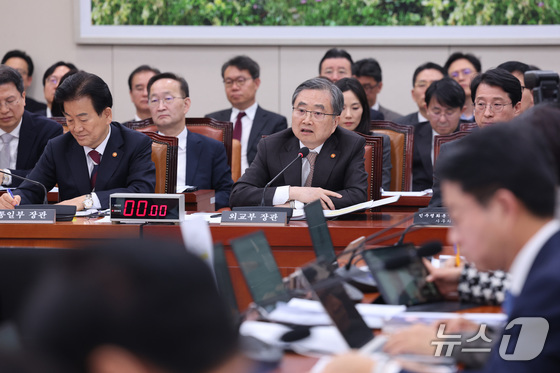
The National Assembly’s Foreign Affairs and Unification Committee is set to discuss on Tuesday on South Korea’s response to U.S. President Donald Trump’s request for naval deployment to the Strait of Hormuz.
A committee official told News1 that while it initially planned to debate bills, they’ve agreed to address current issues instead. This will include questions about President Trump’s request for South Korea and four other nations to send warships to the Strait of Hormuz.
The committee had originally scheduled a bill review for the Foreign Ministry, but with Foreign Minister Cho Hyun’s attendance, they’ll also tackle the Middle East situation.
The focus will likely be on Trump’s naval deployment request. On March 15, Trump posted on Truth Social that many countries, particularly those affected by Iran’s attempts to block the Strait of Hormuz, would send warships to keep it open and secure. He specifically mentioned South Korea among five countries. Trump also revealed that the U.S. and its allies are forming a multinational maritime coalition to protect the strait, having contacted about seven nations.
Both ruling and opposition parties are approaching the deployment cautiously. Rep. Kim Young-bae, the ruling party’s committee secretary, stated that while it’s unclear if the naval presence would improve the situation, it can’t outright reject our ally’s request. It must consider the relationship with Iran too. He stressed the need for careful management through close party-government consultations.
Opposition secretary Rep. Kim Gun advised on Facebook that the government should closely monitor major countries’ responses and consider participation that minimizes the risk of direct war involvement. It needs to make decisions based on calm, realistic criteria.
Lawmakers from both sides are already emphasizing the need for parliamentary approval. People Power Party floor leader Song Eon-seok said that the Strait of Hormuz is a potential combat zone. Deploying the military is a major decision that clearly requires parliamentary consent under the Constitution and laws.
Democratic Party Rep. Kim Byung-joo echoed this sentiment on MBC Radio, saying that given the war situation and our potential inclusion in a multinational force, parliamentary consent seems necessary. It’s in the national interest and allows them to carefully consider the options and buy time.
The Constitution mandates parliamentary consent for overseas deployments. However, the Moon Jae-in administration didn’t seek separate approval when sending the Cheonghae Unit to the Strait of Hormuz in January 2020. They argued that the existing deployment consent bill allowed for operational expansion in emergencies.
Blue House communications chief Lee Kyu-yeon stated in a briefing that they’re approaching this matter very cautiously. It needs sufficient time and thorough discussions with the U.S. before making any decision.