

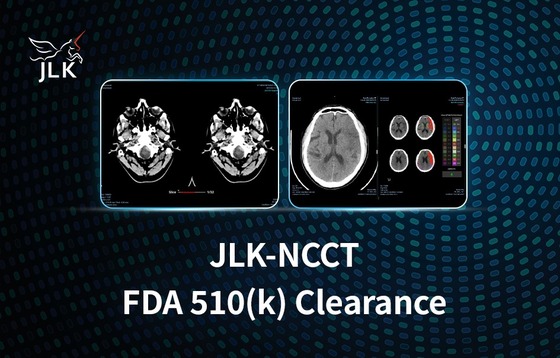
JLK Inc., a medical artificial intelligence (AI) company, said its non-contrast CT (NCCT)-based stroke analysis solution “JLK-NCCT” has received 510(k) clearance from the U.S. Food and Drug Administration (FDA).
The clearance is significant in that it recognizes the clinical value of AI technology that supports rapid identification and prioritization of suspected stroke patients at the non-contrast CT stage, which is typically the first step in stroke diagnosis.
“JLK-NCCT” is designed to screen for suspected intracranial hemorrhage while also identifying patients with suspected large vessel occlusion (LVO) among ischemic stroke cases who may require intervention. Notably, it enables early detection of LVO at the NCCT stage, which is generally assessed through CT angiography (CTA), allowing for faster patient triage and response in emergency settings.
By enabling early identification of patients with suspected cerebrovascular occlusion and prioritizing those requiring urgent procedures such as thrombectomy, the solution is expected to play a key role in securing the critical “golden time” in stroke treatment.
While existing major solutions have focused primarily on analyzing the internal carotid artery (ICA) and the M1 segment of the middle cerebral artery, “JLK-NCCT” expands its scope to include not only ICA and M1 but also the peripheral M2 segment, enabling more precise detection of occlusions across a broader vascular territory.
The 510(k) clearance is also expected to serve as a key turning point in the strategic expansion of JLK’s stroke AI portfolio.
A JLK official said, “By enabling AI to intervene from the earliest stage of stroke diagnosis to rapidly identify suspected patients and support triage and response, this milestone is expected to serve as an important catalyst for expanding revenue in the U.S. market.”
The company added, “Building on the initial entry point secured through the NCCT-based solution, we plan to progressively expand the use of our AI solutions across the full stroke care pathway, including CTA, CT perfusion (CTP) and MRI.”