

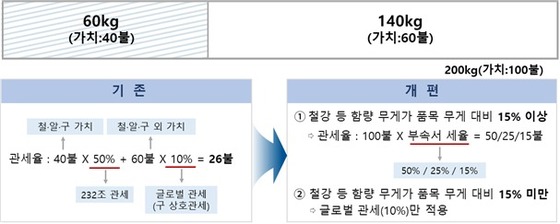
The U.S. government’s restructuring of tariffs under Section 232 of the Trade Expansion Act, which affects steel, aluminum, copper, and related products, has prompted the South Korean government to launch an urgent review amid concerns of industry disruption. The Ministry of Trade, Industry, and Energy is set to convene a public-private joint meeting to assess the impact on various sectors and address business concerns.
The Ministry announced a Public-Private Joint Review Meeting on the Restructuring of Section 232 Tariffs on U.S. Steel, Aluminum, Copper, and Derivatives scheduled for 10:00 a.m. (Korean time) on Thursday at the Seoul Chamber of Commerce and Industry.
On Monday, at 12:01 a.m. (Korean time), the U.S. government implemented changes to the method for imposing Section 232 tariffs. The key modification simplifies the tariff calculation by basing it on the customs price, eliminating the complex system of separately calculating tariffs on the value of steel, aluminum, and copper within products.
The meeting, chaired by Trade Minister Yeo Han-koo, aims to provide a detailed explanation of these changes, gather feedback on sector-specific impacts and challenges, and discuss strategies for Korean companies to navigate the new landscape.
Industry representatives are expected to voice concerns about practical implementation difficulties, potential unforeseen disadvantages for small and medium-sized enterprises, and uncertainties in the evolving trade environment.
To minimize disruption, the Ministry plans to enhance information dissemination and support for businesses.
As an initial step, the government has streamlined access to information on affected harmonized system (HS) codes and applicable tariff rates through the Korea Trade-Investment Promotion Agency (KOTRA)’s Trade Barrier 119 website.
Furthermore, on April 17, the Chamber of Commerce will host a detailed briefing on the key aspects of the system changes and response strategies for companies. This will be followed by a series of nationwide explanatory sessions.
Trade Minister Yeo emphasized that this restructuring reflects some of the concerns that the government and industry have persistently raised through various channels, including high-level discussions and formal communications. It will carefully review industry feedback and advocate effectively on their behalf. To mitigate the impact on businesses, it’s proceeding with support programs, including the announcement of applications for the secondary compensation project in April.