
Monday, May 25, 2026

Reviving Korean Heritage: The MET’s Chilbo Mountain Painting Restored to Original Screen Format

The MET is restoring the Joseon-era painting Chilbo Mountain, aiming to showcase Korean art globally and highlight preservation techniques.

Eli Lilly vs. Novo Nordisk: A $1.2 Billion Bet Reveals Two Very Different Futures for Obesity Drugs

Eli Lilly and Novo Nordisk are pursuing different strategies in the obesity treatment market, focusing on expansion versus core strengths.

THE SNAKE CUT: Is Lee Jae Myung Sacrificing An Ally To Hide The North Korea Cash Trail?

Former Suwon Deputy Mayor faces a 1.5-year prison sentence for leaking documents in a North Korea remittance case amid his mayoral bid.

Revolutionary Imaging Technique for Early Detection of Pregnancy Complications: How Light and Sound Transform Placenta Monitorings

HealthRevolutionary Imaging Technique for Early Detection of Pregnancy Complications: How Light and Sound Transform Placenta Monitorings
A joint research team led by Professor Kim Cheol-hong from the Graduate School of Convergence Science and Engineering at POSTECH (Department of Electrical and Electronic Engineering, Department of IT Convergence Engineering, and Department of Mechanical Engineering), Professor Choi Won-seok from The Catholic University of Korea, and Hebei Medical University in China has developed a medical imaging technology that enables precise observation of the placenta using light and sound. From left: POSTECH Professor Kim Cheol-hong; Lee Dong-hyun, integrated program student in the Department of IT Convergence Engineering; Kim Ji-woong, integrated program student in the Department of IT Convergence Engineering; Dr. Heo Jin-seok, Department of Electrical and Electronic Engineering; Jeon Hyun-seo, integrated program student in the Department of IT Convergence Engineering; and Professor Choi Won-seok, Catholic University of Korea College of Medicine (Provided by POSTECH) 2026.4.7 / News1

A groundbreaking study led by Professor Kim Cheol-hong from Pohang University of Science and Technology’s (POSTECH) Department of Electrical Engineering and Information Technology (IT) Convergence, in collaboration with Professor Choi Won-seok from Catholic University and researchers from Hebei Medical University in China, has unveiled a revolutionary technique for observing the placenta using cutting-edge medical imaging technology that combines light and sound.

POSTECH announced on Tuesday that this innovative research enables precise placental observation and early detection of pregnancy-related complications.

The placenta, a vital organ crucial for both maternal and fetal health, has long been challenging to study due to its temporary nature. To address this, the research team turned to photoacoustic imaging as a promising alternative to conventional ultrasound examinations.

Photoacoustic imaging harnesses ultrasound signals produced when hemoglobin in blood absorbs light, offering simultaneous visualization of vascular structures and oxygen levels. By integrating this method with traditional ultrasound’s deep tissue penetration capabilities, researchers can now comprehensively analyze placental structure, blood flow, and oxygen supply in a single examination.

Professor Kim Cheol-hong explained that its approach combines photoacoustic imaging with state-of-the-art ultrasound techniques to simultaneously assess placental blood flow and oxygen supply, overcoming the limitations of traditional ultrasound. This advancement is expected to significantly improve the early prediction and accuracy of major complications such as preeclampsia, fetal growth restriction, and premature birth.

The team’s findings have been published in the prestigious international journal Science Advances.
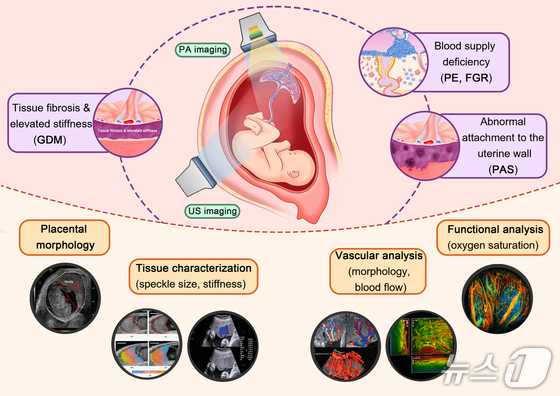
Research image from the joint research team led by Professor Kim Cheol-hong of POSTECH (Provided by POSTECH) 2026.4.7 / News1

Check Out Our Content

Check Out Other Tags:

Most Popular Articles