

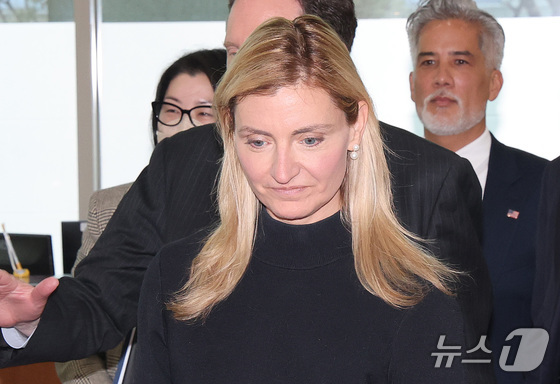
On Tuesday, Sarah Rogers, the U.S. Deputy Assistant Secretary for Public Diplomacy, expressed concerns about potential excessive censorship related to South Korea’s proposed amendments to its Information and Communications Network Act. However, she remained optimistic about cooperation with South Korea.
Rogers shared these insights during a briefing for Korean and Japanese media at the Foreign Press Center in Washington, D.C., where she discussed outcomes of her recent visits to South Korea and Japan.
When asked about U.S. government concerns regarding the proposed amendments, she identified three key provisions under discussion.
Rogers first highlighted worries about legal language ambiguity. She noted that the bill contains definitions that could vary depending on interpretation, adding that vague definitions of concepts like public interest or human dignity could lead to excessive censorship.
She continued that as they’ve seen in Europe, ambiguously written prohibitions imposed on large corporations can result in excessive censorship of expression.
Consequently, Rogers stated that it hopes for thorough, step-by-step communication between the government and businesses to limit potential excessive expression censorship.
The second concern involves the Korea Communications Commission’s (KCC) authority to inspect content management systems.
Rogers described this as a risk assessment and content management structure imposed on tech companies. She questioned whether the KCC’s authority to inspect companies’ content management systems might create undue pressure for them to regulate expression in ways that align with government preferences. She added that such structures increase the risk of chilling free speech.
The third concern pertains to the potential disproportionate impact of regulations on large platforms affecting U.S. companies.
Rogers remarked that when dealing with foreign technology regulations in Europe, South Korea, and elsewhere, it often sees provisions targeting large platforms. She emphasized that as an advocate for the U.S., She’s also advocating for American industries.
She further stated that any regulatory provisions that impose disproportionate burdens on U.S. companies compared to their competitors are issues I will raise as an advocate for American interests.
However, Rogers assessed the discussions with South Korean officials positively. She noted that it had very productive conversations on this topic, and overall, the dialogue was constructive and left me optimistic about our cooperation.
She specifically pointed out that South Korean officials recognize the burdens on American companies and the issue of potential chilling effects on political expression. Rogers mentioned that it discussed how defamation-type provisions would apply only to demonstrably false statements, not to contentious political claims. This was a very productive conversation.
When asked if the upcoming amendments to South Korea’s Information and Communications Network Act could lead to U.S. trade pressure or a Section 301 investigation, she avoided a direct answer.
She’ll defer to the U.S. Trade Representative (USTR) regarding Section 301, she said. During her visit to South Korea, Rogers also discussed various levels of cooperation in shipbuilding personnel training, stating that they’re making ongoing progress in this area.
Regarding her meetings with North Korean defectors, she shared that interacting directly with people who grew up in a closed information environment was a profoundly impactful experience.
She added that while debates over free speech are significant in the U.S., most Americans can’t fathom growing up in an environment where freedom of expression is nonexistent.
She continued that in such places, merely listening to foreign broadcasts can lead to torture or execution.
Rogers particularly emphasized how even small fragments of information encountered by North Korean defectors changed their lives.
The small snippets of broadcasts they heard transformed their lives, she said, recounting an example of a defector who accidentally learned about the treatment of U.S. troops stationed in South Korea.
Rogers explained that while it wasn’t propaganda promoting U.S. military service, it was shocking for someone raised in an environment of near-unpaid conscription.
Another example involved a defector who first encountered the concept of career choice through a foreign reality show.
Witnessing people choosing their careers in an open society was an eye-opening experience for the defector, she noted.
Rogers emphasized that this served as a powerful reminder of how crucial access to information is in a closed society.
She also mentioned the real risks faced by North Korean defectors. They often escape leaving their families behind and must conceal their identities for safety, she said, adding that reality deeply resonated with her.
Regarding U.S.-South Korea cooperation in shipbuilding, Rogers stated that it needs to develop a range of personnel, from welders to advanced designers. She elaborated that it discussed training timelines and the methods and locations for vessel production. She believes it’s making steady progress in this area.
Meanwhile, Rogers has been nominated as the director of the U.S. Agency for Global Media and is currently undergoing Senate confirmation.