

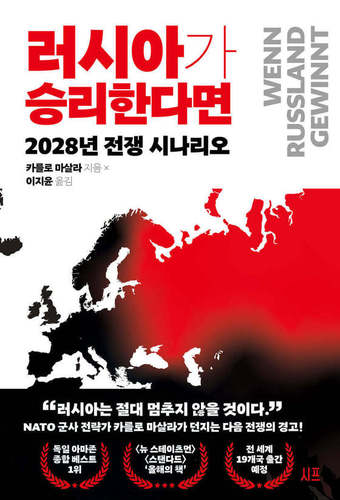
What If Russia Wins? is a future scenario report crafted by a German security expert based on rigorous military simulations. The premise – whether the North Atlantic Treaty Organization (NATO) would risk nuclear war over a small Estonian town – mirrors the long-standing security question: Would the U.S. sacrifice San Francisco to defend Seoul?
The Seoul-San Francisco Dilemma encapsulates the uncertainty about whether the U.S. would defend South Korea at the risk of its own cities if North Korea’s nuclear threat became real.
This dilemma extends to Europe. The book meticulously examines how NATO and the global order could unravel leading up to a Russian takeover of Narva, an Estonian border town, in 2028.
Set in March 2028, the narrative explores whether NATO’s Article 5 would be invoked when Narva is attacked, a question that threatens to fracture the alliance. Rather than fiction, the book presents a scenario grounded in military simulations.
Russia’s strategy isn’t limited to conventional warfare. It employs hybrid tactics: weaponizing refugees, assassinating key figures, launching cyberattacks, and waging disinformation campaigns using deepfakes. As the conflict spreads beyond borders, the alliance’s decision-making process grinds to a halt.
The author’s critique extends beyond Russia’s military capabilities. He identifies greater threats in U.S. isolationism, European disunity, leadership paralyzed by escalation fears, and a crumbling collective defense system. The core question – whether NATO would risk nuclear war over a small town – strikes at the heart of the alliance.
These scenarios resonate with familiar security concerns. The Estonian dilemma echoes the question of whether the U.S. would risk San Francisco to defend Seoul. Through Europe’s crisis, it prompts a reevaluation of alliance dynamics, deterrence strategies, and nuclear fears.
Carlo Masala clearly outlines the scenario’s purpose: to understand potential risks, decisions, and consequences, we must first envision what could unfold. The book serves more as a strategic rehearsal for worst-case scenarios than a prediction.
The latter half of the book explores a domino effect involving the decline of U.S. hegemony, China’s ascent, South China Sea tensions, and closer ties between Russia and North Korea. It warns that instability in Europe could spread to Asia. Throughout, the book maintains a sobering view that peace cannot be sustained by institutions alone.
This work reads as a stark warning to readers living in what may be a pre-war era rather than a post-war world.