

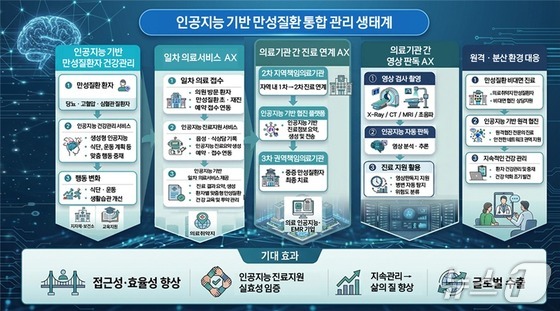
The government unveiled a plan to integrate artificial intelligence (AI) across the full spectrum of healthcare for chronic disease patients, from daily health management to treatment at university hospitals, while accelerating the commercialization of related AI products.
The Ministry of Health and Welfare said Wednesday it will actively support the rapid market entry of AI-based solutions for managing conditions such as hypertension and diabetes.
The ministry outlined the initiative during a project briefing held at the President Hotel in Asia, describing it as part of a broader “AI transformation (AX)” strategy. The concept goes beyond adopting technology, encompassing a comprehensive redesign of workflows, decision-making structures and services around AI.
A total of 11 government ministries are participating in the “AX-Sprint” program, which aims to promote the commercialization of AI products and services that can enter the market within one to two years in sectors closely tied to daily life and industry. The program is backed by $5 billion in funding.
Within this framework, the health ministry will focus on supporting AI-driven solutions for chronic disease management, citing the rising prevalence of such conditions amid rapid population aging and the limitations of treatment-centered healthcare systems in meeting growing demand.
The initiative aims to shift the healthcare paradigm toward prevention and continuous management, while also improving access to medical services in non-metropolitan regions where resources are limited.
The ministry will provide support to companies developing AI-based healthcare products and services, covering six key areas: lifestyle management for chronic disease patients, improvements in primary care such as imaging analysis support, integration of treatment through electronic medical records (EMR), and pilot programs for remote collaborative care. Each project will receive up to $940,000 in funding.
Kim Hyun-sook, director-general for advanced healthcare support at the ministry, said the initiative will embed AI across the healthcare system, enhancing the quality of care from everyday life to tertiary hospitals.
She added that the government plans to introduce a comprehensive “AI basic healthcare strategy” in the first half of the year to provide more structured policy support.
A central component of the strategy is the creation of a “public healthcare AI highway,” designed to significantly strengthen coordination among primary, secondary and tertiary medical institutions using AI, enabling patients to access appropriate care regardless of location.
The system will leverage national GPU (graphics processing unit) infrastructure to distribute and allocate optimized AI services in real time to national university hospitals across the country, supporting the adoption of AI in clinical practice at public hospitals.
The government aims to fully launch and operate the system by 2029.