

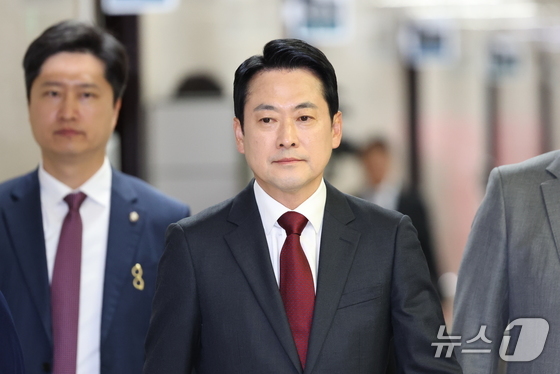
After concluding a nine-day visit to the U.S., Jang Dong-hyuk, the leader of the People Power Party, resumed his duties on Monday. He reported that numerous American officials expressed concerns about the Lee Jae Myung administration’s ambiguous stance on North Korea policy and the U.S.-South Korea alliance.
During a Supreme Council meeting at the National Assembly that morning, Jang stated that he had busy meetings with key figures driving U.S. policy, including members of Congress, the White House National Security Council (NSC), the State Department, and influential think tanks.
Referring to North Korea’s ballistic missile launches, he criticized that the sharing of crucial U.S. intelligence, our most vital security asset, is currently restricted. This is due to President Lee’s alignment with Unification Minister Chung Dong-young’s irresponsible statements and silence.
Regarding the Middle East conflict and the Strait of Hormuz blockade, Jang noted that even after the war ends, the impact on the economy is inevitable. To accelerate post-war recovery and improve living conditions, strengthening the trade network based on the U.S.-South Korea alliance is paramount.
He added that however, the U.S. is intensifying pressure on the economy by pursuing investigations under Section 301 of the Trade Act. The Lee administration’s anti-U.S. and anti-business policies, including the defense crisis, are hindering the economic progress.
Jang reported that during his U.S. visit, he had to make substantial efforts to explain the citizens’ support for the U.S.-South Korea alliance and to rebuild trust with American officials. He mentioned in-depth discussions on North Korean denuclearization strategies with senior NSC officials and talks on enhancing economic cooperation with high-ranking State Department officials.
He stated that he secured commitments regarding visa issues for South Korean companies in the U.S., but warned that however, no matter how hard the opposition party tries, if the government and ruling party persist in their current direction, its efforts will be futile. The consequences will ultimately fall on the citizens and businesses.
Jang urged President Lee, saying that even now, he must fundamentally revise North Korea policy and diplomatic strategies based on national security and interests. He emphasized that the president must also immediately address his social media addiction, which is disrupting the diplomatic efforts.