

![North Korean leader Kim Jong Un oversees a nuclear weaponization project on March 27, 2023. At the time, North Korea unveiled what appeared to be a newly mass-produced nuclear warhead named “Hwasan-31.” [For Use Only in the Republic of Korea. Redistribution Prohibited. DB Prohibited] / Courtesy of News1](https://contents-cdn.viewus.co.kr/image/2026/04/CP-2022-0006/image-29b41dc6-35e5-4382-b0a6-5c20b51fe4d4.jpeg)
North Korea’s short-range ballistic missile (SRBM) “Hwasong (Hwasong)-11Ra,” test-fired on April 20 with a cluster warhead, indicates the strengthening of forward corps responsible for operations against South Korea while also showcasing the regime’s “byungjin” policy of simultaneously developing nuclear and conventional weapons, an analysis said on April 24.
Attendance by front-line corps commanders and 136 km range imply strengthened threat to South Korea
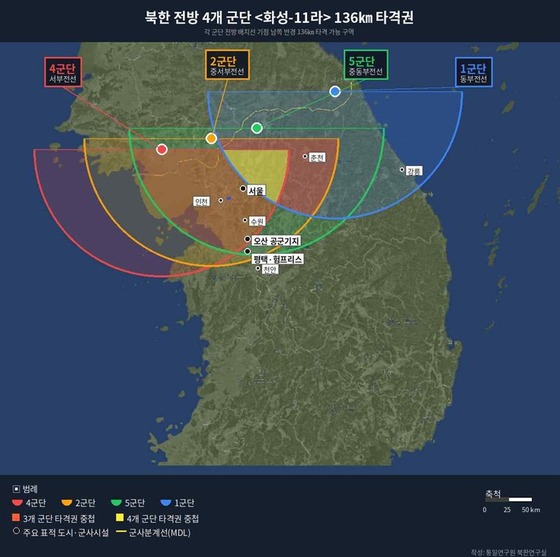
Hong Min, a senior research fellow at the Korea Institute for National Unification, said in a report titled “Analysis of North Korea’s Hwasong-11Ra Tactical Ballistic Missile Test Launch” that understanding the tactical implications of the test requires examining the spatial coverage of the missile’s strike range of 136 km observed in the latest launch.
During the test, North Korea had commanders of its forward 1st, 2nd, 4th and 5th Corps attend, suggesting the missile is intended as a weapon operated by front-line corps for use against South Korea. Its range is therefore directly linked to South Korea’s security, the report noted.
According to Hong, a 136 km range from the 4th Corps, which covers the western front (Kaesong-Haeju axis), includes the entire Seoul metropolitan area. This encompasses Camp Humphreys in Pyeongtaek (about 100–110 km), the Osan Air Base (about 90 km), as well as areas including Songtan, Anjung, Cheonan and Asan.
If launched from the 2nd Corps, responsible for the central front (Cheorwon-Pyonggang), the missile could cover the entire Seoul metropolitan area as well as Suwon, Icheon, Yeoju and key industrial belts in southern Gyeonggi Province. For the 1st and 5th Corps, which cover the mid-eastern and eastern fronts, cities such as Chuncheon, Hongcheon, Wonju, Gangneung and Yangyang fall within range, along with major command facilities such as the 1st Corps headquarters in Wonju.
Hong said the strike range helps fill a gap between North Korea’s existing multiple rocket launchers with ranges of 40–400 km (240 mm, 300 mm, 600 mm) and its short-range ballistic missiles with ranges of 400–600 km, including the Hwasong-11Ga, 11Na and 11Da.
He also noted that the latest test demonstrates the operationalization stage of a tactical ballistic missile system for forward corps that North Korea has developed over four years. The Hwasong-11Ra has progressed through stages including initial unveiling (April 16, 2022), force structure exposure (April 25, 2022), designation of operating units and tactical nuclear payload (March 2023), guidance precision improvements (May 2024), deployment and mass unveiling (August 2024), and diversification of warheads (April 2026).
The presence of all commanders of the 1st, 2nd, 4th and 5th Corps at the test also signals that the Hwasong-11Ra has been integrated as an organic firepower asset of corps units rather than remaining under strategic forces or missile command. With high-precision guided ballistic missiles now assigned to front-line corps, commanders can directly control ballistic missile launches, unlike in the past.
Nuclear or “asymmetric warheads”…a dual-use platform with selectable payloads
Hong said the Hwasong-11Ra symbolizes North Korea’s “byungjin” policy of parallel nuclear and conventional weapons development, as it serves as a “dual-use platform” capable of carrying both tactical nuclear and conventional warheads.
In March 2023, North Korea first unveiled what appeared to be a nuclear warhead or nuclear cartridge named “Hwasan-31” during an event where leader Kim Jong Un guided a nuclear weaponization project. A display listing compatible missiles included the Hwasong-11Ra.
If North Korea’s claim that the recent test launch involved equipping the Hwasong-11Ra with conventional cluster and fragmentation mine warheads is accurate, the missile would function as a versatile platform capable of carrying both nuclear and conventional payloads.
Recent reports by North Korea have also referenced the concepts of “high-precision strikes” and “high-density suppression strikes,” which Hong said may be designed to highlight asymmetry with South Korea-U.S. defense doctrines. “High-precision strikes” refer to point-target destruction of command posts, radar systems and hangars, while “high-density suppression strikes” refer to area-target attacks aimed at neutralizing maneuver and defense capabilities.
The South Korea-U.S. missile defense (MD) system is optimized to intercept precision attacks on point targets. If North Korea enhances area-suppression capabilities using cluster warheads that can inflict damage over a wide area with a single missile, it could complicate prioritization for interception, as it is difficult to determine the type of warhead after launch.
“North Korea appears to have demonstrated through recent missile tests that it can achieve the full cycle of destruction, blockade and precision strikes within a single missile system simply by selecting different warheads,” Hong said.