

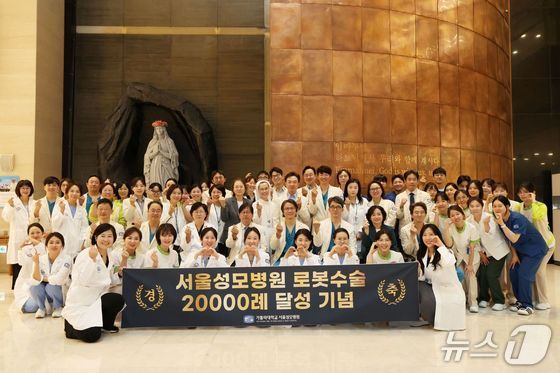
The Catholic University of Korea Seoul St. Mary’s Hospital has reached a milestone of 20,000 robotic surgeries. This achievement follows their record-setting 10,000 surgeries performed in the shortest time nationwide in 2022, further solidifying their expertise in clinical experience and patient-centered precision medicine.
The hospital commemorated this remarkable feat with a ceremony held in the main lobby on Monday.
Robotic surgery, a cutting-edge minimally invasive technique, employs precisely controlled robotic arms to minimize bleeding and pain while accelerating patient recovery.
The hospital has broadened its surgical offerings to include state-of-the-art single-port robotic procedures, delivering personalized treatments that account for disease progression, surgical complexity, and individual patient anatomy.
Of the 20,000 robotic surgeries performed, a significant 20% were single-port procedures, utilized across various medical specialties.
Single-port robotic surgery involves inserting a specialized device through a single incision, then using a high-definition three-dimensional (3D) camera and advanced robotic instruments to perform the operation.
This innovative approach minimizes scarring and pain while enhancing aesthetic outcomes and speeding up recovery.
Despite the heightened skill requirements for visibility and instrument manipulation compared to traditional multi-port robotic surgeries, this method is highly effective for precise operations on deep-seated lesions.
Notably, the hospital conducted approximately 20% (3,798 cases) of its total robotic surgeries using the single-port technique.
While single-port surgeries are typically reserved for benign tumor treatments due to their complexity, the hospital has pushed boundaries by using this approach for 73% of cancer treatments as of 2024.
In kidney cancer treatment, for instance, the hospital has successfully implemented partial nephrectomies using single-port robotic surgery.
Given the kidney’s rich blood supply, this procedure requires exceptional surgical skill to temporarily block blood flow, precisely excise cancerous tissue, and complete the operation swiftly.
Dr. Hong Seong-hoo, head of the hospital’s robotic surgery center, continues to achieve outstanding results in cancer removal while preserving kidney function, significantly reducing post-operative dialysis risks.
The hospital has also adapted single-port robotic surgery techniques to suit various medical specialties.
Breaking down robotic surgeries by department, urology leads with 38%, followed by obstetrics and gynecology at 31%, general surgery at 28%, and otolaryngology at 3%.
By specific conditions, the data shows 27% for uterine procedures, 19% for prostate, 13% for kidney, 9% for thyroid, 8% for hepatobiliary, 6% for colorectal, 4% for gastric, and 3% for ovarian surgeries.
The hospital has also successfully tackled complex adrenalectomies using robotic techniques, yielding impressive recovery times.
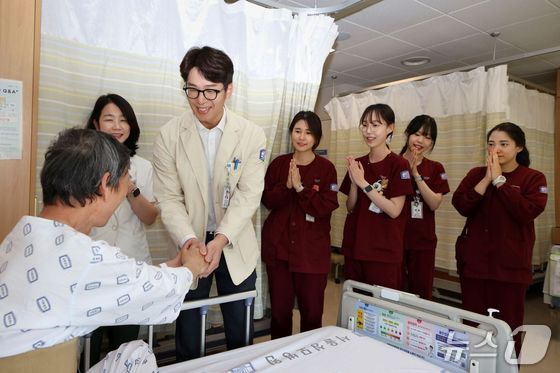
The milestone 20,000th surgery was a single-port robotic procedure performed by Dr. Kim Kwang-soon, an endocrine surgery specialist.
The patient, diagnosed with primary aldosteronism after extensive monitoring, underwent a single-port robotic retroperitoneal adrenalectomy.
Primary aldosteronism results from overproduction of aldosterone by the adrenal glands, leading to uncontrolled hypertension, low potassium levels, and electrolyte imbalances.
As medication alone often proves insufficient and the condition risks serious cardiovascular complications if left untreated, surgical intervention is the recommended course of action.
Adrenalectomies are considered high-difficulty surgeries due to their relative rarity and complex anatomical approach.
Few hospitals in South Korea possess the specialized robotic surgical expertise required for these procedures, which differ significantly from traditional laparoscopic methods.
Dr. Kim highlighted the benefits of this approach, noting that this surgery doesn’t impact abdominal organs, eliminating the need for post-operative fasting. Patients experience less pain, leading to faster recovery.
The procedure lasted under an hour, allowing the patient to be discharged the following day – a stark contrast to the week-long hospital stays typical of conventional surgeries.
Dr. Hong emphasized the hospital’s commitment, stating that they’re dedicated to advancing robotic surgery through the specialized techniques and interdisciplinary collaboration. The goal is to provide patients with the most advanced surgical care possible.
The hospital boasts a state-of-the-art robotic surgery fleet, including four fourth-generation Da Vinci Xi systems and one Da Vinci SP. Additionally, they’ve established a robotic surgery training center to provide ongoing education for medical professionals.