

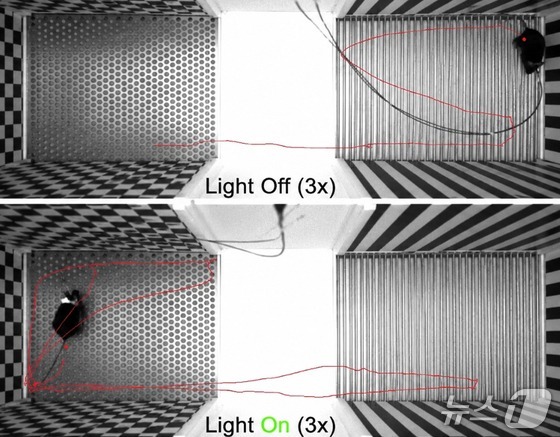
South Korean researchers have identified for the first time a “neural switch” in the brain that selectively retrieves recent memories.
KAIST said May 17 that a research team led by professor Han Jin-hee discovered that a specific neural circuit connecting the brain’s medial septum (MS) and medial entorhinal cortex (MEC) plays a key role in switching between older and newer memories and selecting the most relevant information for a given situation.
The ability to choose relevant information between past and present memories is central to higher cognitive functions such as decision-making, problem-solving, future prediction and logical reasoning. However, scientists have long struggled to explain how the brain distinguishes and switches between memories.
Impairments in this memory-switching ability are considered one of the core symptoms associated with neuropsychiatric disorders including schizophrenia, autism spectrum disorder and early-stage Alzheimer’s disease.
The research team focused on the medial septum, a deep brain structure that acts as a “conductor” by regulating hippocampal rhythms and helping the brain efficiently store and retrieve information.
The study found that when certain neurons in the medial septum transmitted signals to the medial entorhinal cortex — a brain region that processes memory information and relays it to the hippocampus — the brain became better at recalling recent memories.
Conversely, animal experiments showed that when researchers artificially blocked this neural circuit using light, subjects failed to use updated information and instead behaved according to older memories and past patterns.
Neural activity in the hippocampus, which plays a major role in memory storage, also reverted to earlier patterns when the circuit was blocked. Researchers said this demonstrated that the circuit functions as a “neural switch” that selects the most relevant and up-to-date information among competing memories.
The team also analyzed how different brain activity states affect memory performance. The brain continuously alternates between an “online state,” in which it actively processes information, and an “offline state” associated with rest.
Researchers found that the longer the brain remained in the online state, the better subjects were at recalling recent memories. In contrast, frequent switching between online and offline states significantly reduced memory retrieval performance.
The findings suggest that specific brain rhythms and activity states serve as important neurological indicators for effective memory recall.
The research team said the study is significant because it identifies the mechanism that allows the brain to preserve older memories while still flexibly incorporating new information. The findings could eventually contribute to new treatments aimed at improving memory decline and reduced cognitive flexibility in patients with degenerative brain disorders such as dementia and Alzheimer’s disease.
“This study presents a new paradigm for understanding how the brain organizes and uses countless experiences in chronological order,” Han said. “We demonstrated that the brain has a regulatory system capable of actively selecting the most recent information among competing memories.”
The study, which included KAIST researchers Kim Moo-jun, Seo Bo-in, So Sun-hoe, Choi Jung-wook, Hwang Jae-min and Park Joo-hee, was published in the international neuroscience journal Nature Neuroscience.
The research was supported by South Korea’s National Research Foundation, the Samsung Future Technology Incubation Foundation and the KAIST Jang Young-shil Fellowship program.