

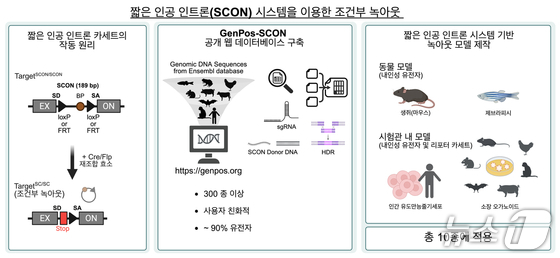
Institute for Basic Science (IBS) said Wednesday that researchers at its Center for Genome Engineering have successfully expanded a conditional gene knockout technology known as SCON to multiple biological systems, including zebrafish, human induced pluripotent stem cells, and organoids.
Gene function studies often require experiments that remove or suppress specific genes. However, genes essential for survival frequently cause cells or organisms to die immediately when removed, making it difficult to study their functions. To address this, researchers have relied on conditional knockout (ckO) technologies that allow genes to be turned off only at specific times.
Existing technologies, however, have faced limitations in systems such as zebrafish and human stem cells because of technical complexity and low efficiency.
To overcome those issues, the IBS team utilized SCON technology, which allows researchers to remove specific genes more simply. SCON works by inserting a short artificial DNA sequence into a target gene and later using a specific enzyme to selectively disable the gene’s function when needed.
Because the structure is relatively simpler than conventional conditional knockout methods, the technology has been considered potentially applicable across a wide range of species.
Experiments in zebrafish confirmed that even genes essential for survival could be selectively controlled at desired time points using the system.
The team also validated the SCON technology in human induced pluripotent stem cells. After inserting SCON into genes important for cell growth and development, researchers used drug treatment to successfully disable those genes. Some cells were later observed to die over time.
The SCON system also functioned successfully in intestinal organoids derived from mice, rats, chickens, bats, pigs, and monkeys, demonstrating that the technology could be broadly applied across diverse animal species.
Based on the findings, the researchers built a web platform called “GenPos-SCON,” which contains genomic information for 308 vertebrate species. The platform allows researchers to input desired species and genes and easily obtain experimental design information.
The team said future plans include expanding and upgrading the platform, adding convenience features, and broadening SCON applications into multi-conditional knockout systems.
Koo Bon-kyung, director of the research center, said the study could help make human disease research and developmental biology studies “far more precise and diverse” by expanding the range of species and systems where the technology can be applied.
Corresponding author Lee Hee-tak said that even highly advanced technologies face limitations if accessibility remains low.
“Based on this achievement, researchers in Korea and abroad will be able to translate new research ideas into experiments more quickly,” Lee said.
The study was published online in the international academic journal Nucleic Acids Research.