

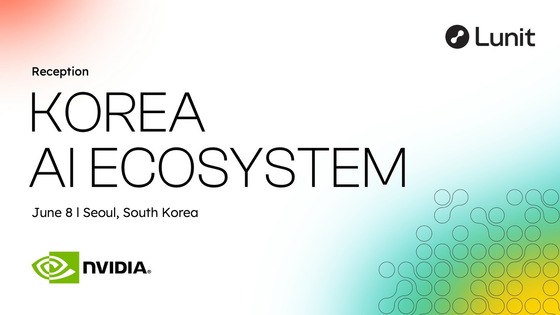
South Korean medical artificial intelligence company Lunit said it has been invited to participate in Nvidia’s AI Ecosystem Meeting on June 8 in Seoul, where the company will discuss potential collaborations in healthcare AI amid growing interest in sovereign AI initiatives.
The event, held at The Shilla Seoul during Nvidia CEO Jensen Huang’s visit to South Korea, brings together leaders from major companies and institutions involved in building the country’s AI infrastructure ecosystem.
The meeting comes as Nvidia expands partnerships with governments and industries worldwide to develop sovereign AI capabilities — the ability of nations to build, operate and control AI systems using their own infrastructure, data and talent. Sovereign AI has become a central pillar of Huang’s global AI strategy.
Representing the healthcare AI sector, Lunit plans to meet with Huang and other industry leaders to discuss opportunities for collaboration in medical foundation models and national-scale healthcare AI initiatives. The company said it will highlight its experience supporting government and public-sector cancer screening programs across multiple countries.
Lunit is currently leading a consortium of 23 academic, research, healthcare and industry organizations in South Korea to develop a medical science-focused foundation model as part of a government-backed project. The company recently released the first version of the model, known as L1, as open-source software.
L1 is designed for clinical reasoning and medical decision support and utilizes an efficient architecture aimed at delivering strong performance with relatively low computational requirements. According to Lunit, the model has demonstrated competitive results on major global healthcare AI benchmarks, including OpenAI’s HealthBench evaluation framework.
The company has built a presence in more than 10 countries across Europe, the Middle East, Asia and Australia through national and public-sector cancer screening programs. Lunit said these large-scale deployments have provided valuable experience in integrating AI into real-world healthcare systems.
More recently, the company has expanded its focus beyond diagnostic imaging to foundation models and broader healthcare AI infrastructure, positioning itself to support the digital transformation of medical institutions.
“As sovereign AI expands into healthcare, countries increasingly need trustworthy AI systems that reflect their own medical data and population characteristics,” said Sungwon Yoo, chief technology officer of Lunit. “By combining our open medical foundation model with experience gained from national-scale screening programs, we hope to work with global partners to advance the healthcare AI ecosystem.”
Lunit also highlighted its growing footprint in the United States following its acquisition of breast imaging software company Volpara, now operating as Lunit International, in 2024. The acquisition expanded the company’s presence in the U.S. breast cancer screening market and strengthened its strategy of building an AI-powered software ecosystem that automates and connects the entire screening workflow.
Through its focus on workflow automation and integrated screening infrastructure, Lunit aims to address operational challenges facing healthcare providers while expanding the adoption of AI across clinical settings.