

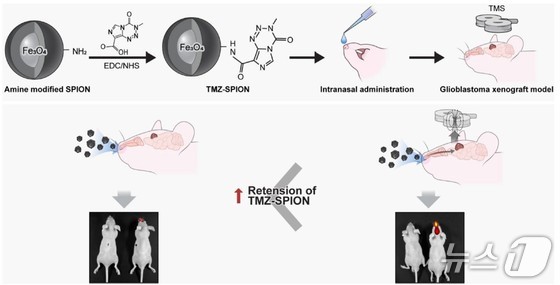
A team of Korean researchers has developed a groundbreaking drug delivery technique that administers anti-cancer nanoparticles through the nose and precisely guides them to malignant brain tumors, specifically glioblastomas, using magnetic fields. Initial tests on animal models have shown promising results, significantly extending survival rates.
On Juen 11, Professor Yang Seung-ho from Seoul St. Mary’s Hospital, along with Professors Park Sung-min and Kim Won-jong from Pohang University of Science and Technology (POSTECH), announced their collaborative research project. Their innovative method involves delivering anti-cancer nanoparticles nasally and guiding them to tumor sites using magnetic fields.
Glioblastoma, an aggressive form of brain cancer, accounts for approximately 65% of all primary malignant tumors in the central nervous system. In South Korea, about 1,000 new cases are diagnosed annually. Even with standard treatment, the average survival period is only about 15 months, making it one of the most challenging cancers to treat.
Each year, between 2,500 and 4,500 new brain tumor cases are reported in South Korea. Brain tumors, which develop in or around the brain, are categorized into various types including glioblastomas, meningiomas, schwannomas, and metastatic brain tumors. Among these, glioblastoma is the most common primary malignant brain tumor, underscoring the urgent need for new treatment options.
Currently, temozolomide, the primary drug used in glioblastoma treatment, is administered orally. However, its effectiveness is limited by the blood-brain barrier (BBB), which prevents sufficient amounts of the drug from reaching the tumor. This results in low treatment efficacy and potential side effects, including systemic immunosuppression.
The research team focused on two key factors: the natural pathway from the nose to the brain via the olfactory nerve, which directly connects to the brain, and the ability to control the movement of magnetic nanoparticles using external magnetic fields.
They synthesized a complex by combining temozolomide with superparamagnetic iron oxide nanoparticles (SPION) and designed a method to administer it nasally, using transcranial magnetic stimulation (TMS) to guide it to the brain tumor site.
In cell experiments, the TMZ-SPION complex demonstrated tumor cell-killing effects comparable to existing drugs. Electron microscopy analysis confirmed that the nanoparticles were evenly distributed within the nuclei of tumor cells.
Animal experiments involved administering the complex to glioblastoma model mice and tracking their survival for 90 days. The results were striking: median survival times were 27 days for the control group, 51 days for the complex-only treatment group, and 72 days for the group receiving complex treatment followed by TMS.
Compared to the untreated control group, the TMS group showed approximately 2.7 times longer survival after receiving the complex, while the complex-only group exhibited about 1.9 times longer survival.
Notably, the drug dosage used in the combination group was only about 5.6% (1/18th) of the standard oral dosage.
Further analysis using liquid chromatography-tandem mass spectrometry (LC-MS/MS), which precisely measures drug concentrations in brain tissue, revealed significantly higher drug concentrations in the brain tissue of the treatment group compared to the untreated group. This demonstrates that TMS effectively enhanced the delivery and retention of the drug in the brain.

Professor Yang, who also serves as the director of the Gamma Knife Center at the hospital and president of the Korean Society of Nanomedicine, commented on the clinical significance of this approach. This method, combining a non-invasive nasal delivery route with transcranial magnetic stimulation, effectively bypasses the blood-brain barrier while greatly reducing side effects associated with traditional cancer treatments, such as systemic immunosuppression, he explained. It hopes this contributes to transforming glioblastoma into a more manageable disease in the long term.
This groundbreaking research was published in the international journal Drug Delivery and Translational Research.