

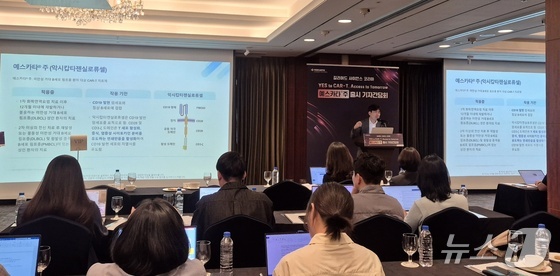
“Yescarta is already widely used as a second-line treatment for patients with very poor survival prospects around the world. Because it has demonstrated a clear survival benefit, it should be adopted quickly as an early standard-of-care treatment in Korea as well.”
Kim Seok-jin, professor of hematology-oncology at Samsung Medical Center, made the remarks during a press conference held by Gilead Sciences Korea and its subsidiary Kite to mark the launch of the chimeric antigen receptor T-cell (CAR-T) therapy Yescarta (axicabtagene ciloleucel).
The event highlighted the clinical value of Yescarta, currently the only CAR-T therapy available in Korea for second-line and later treatment of relapsed or refractory diffuse large B-cell lymphoma (DLBCL), as well as the importance of early intervention.
Yescarta is a genetically engineered CAR-T therapy that targets CD19. The treatment works by modifying a patient’s T cells with genetic information that enables them to recognize the CD19 protein found on B cells. The engineered CAR-T cells are then reinfused into the patient, where they identify and destroy CD19-expressing cancer cells.
Last year, Korea’s Ministry of Food and Drug Safety approved Yescarta for adult patients with DLBCL who relapse within 12 months of first-line chemoimmunotherapy or whose disease is refractory to treatment, as well as adults with relapsed or refractory DLBCL or primary mediastinal B-cell lymphoma (PMBCL) after two or more lines of systemic therapy.
DLBCL is one of the most common forms of non-Hodgkin lymphoma, accounting for approximately 30% of all lymphoma cases. Due to its aggressive nature, the five-year survival rate remains only 55.4%. The incidence of DLBCL in Korea has steadily increased, with an estimated 2,400 new cases annually and a standardized incidence rate of 2.23 cases per 100,000 people.
During the event, Yoon Deok-hyun, professor of oncology at Asan Medical Center, presented on the treatment landscape for relapsed or refractory DLBCL and the need for CAR-T therapy.
“Current reimbursed second-line treatments for relapsed or refractory DLBCL in Korea are based on older cytotoxic salvage chemotherapy regimens,” Yoon said. “Even with aggressive treatment, patients with relapsed or refractory disease have a two-year survival rate of only 20%.”
He added, “It is important to establish an environment in which treatment options capable of improving long-term survival can be used at the appropriate time so patients do not miss their critical treatment window.”
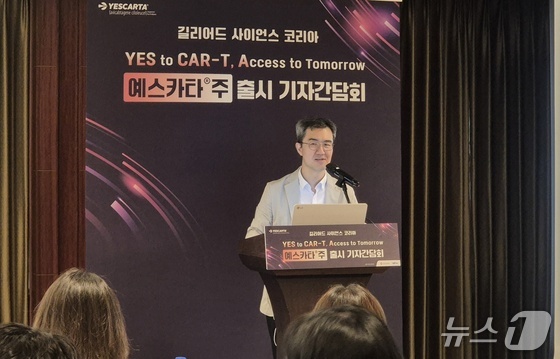
Professor Kim discussed the potential impact of Yescarta’s launch in Korea and reviewed key clinical evidence supporting its use.
Citing results from the global Phase 3 ZUMA-7 trial conducted in the United States, Australia, Canada, Europe and Israel, Kim emphasized the importance of making the therapy available in Korea.
“In the ZUMA-7 study involving adult DLBCL patients who relapsed within 12 months of first-line therapy or were refractory to treatment, Yescarta extended median event-free survival by more than fourfold compared with standard therapy and reduced the risk of relapse or death by 60%, demonstrating the clinical value of early CAR-T treatment,” he said.
“Based on this clinical evidence, Yescarta is recommended by the National Comprehensive Cancer Network (NCCN) as the highest-level recommendation for second-line DLBCL treatment and as a preferred option in the third-line and later settings,” Kim added. “With its launch in Korea, we hope patients with relapsed or refractory DLBCL, who frequently experience recurrence and poor outcomes, will have access to an innovative CAR-T treatment option that can improve their chances of long-term survival.”
Kim Sung-eun, medical director at Kite, noted that Yescarta has been administered to more than 28,700 patients worldwide and has demonstrated efficacy and safety profiles consistent with clinical trial findings.
“In real-world clinical practice, rates of cytokine release syndrome (CRS) and neurotoxicity, two major adverse events associated with CAR-T therapy, have generally been reported to be lower than those observed in registration trials, while clinical experience in managing these events continues to accumulate,” Kim said.
Han Gong-sook, executive director of oncology at Gilead Sciences Korea, said, “The launch of Yescarta in Korea is meaningful because it provides patients with relapsed or refractory DLBCL access to a global standard-of-care treatment that can increase the potential for long-term survival and even cure with a single administration at the second-line treatment stage.”
“We will work closely with healthcare professionals, treatment centers and government authorities to ensure that patients can receive Yescarta in a timely manner,” she added.