

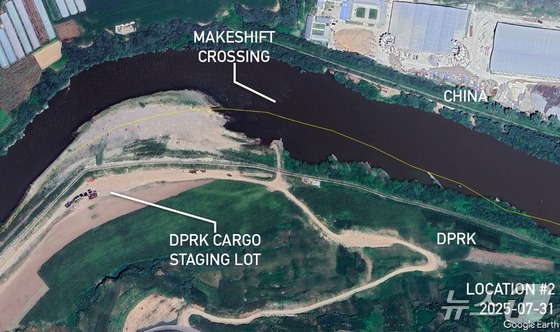
Activity has resumed at numerous unofficial trading sites along the China-North Korea border that Beijing has used to send aid supplies into North Korea, according to satellite imagery. The renewed activity, which began shortly after last month’s summit between the two countries’ leaders, suggests China has restarted sanctions-evasive assistance to strengthen ties with Pyongyang.
According to an analysis of satellite imagery by North Korea-focused outlet NK News, activity resumed at 13 of 34 unofficial trade sites and cargo staging areas along the Yalu River after mid-June. The sites are located near Samsu County in South Hamgyong Province and Kim Jong-suk and Kim Hyong-jik counties in Ryanggang Province.
NK News reported that these locations had been actively used for unofficial cargo transfers from September through the end of last year before activity largely ceased between January and May. Between June 19 and 24, however, satellite imagery detected objects believed to be cargo at five unpaved storage yards on the North Korean side of the river. Similar activity was observed at another five sites on June 28 and 29.
Time-lapse imagery released by NK News showed operations resuming in recent weeks at a North Korean cargo yard in Samsu County, Ryanggang Province. Increased activity was also observed at a nearby railway station during the same period.
The outlet assessed that the cargo was most likely transported from China across the border into North Korea before being shipped further inland. Last year, nearly all goods moved through these sites were believed to have flowed from China into North Korea.
NK News previously reported in December that at least 32 such crossing points had been established along a roughly 59-mile (95-kilometer) stretch of the Yalu River. Located opposite Baishan in China’s Jilin Province, the sites span five areas in North Korea’s Ryanggang Province, including Kim Hyong-jik County, Kim Jong-suk County, Samsu County, Hyesan, and Pochon County.
The outlet described the locations as “temporary crossing points” because neither side installed formal customs facilities. Instead, earthen crossings were built across shallow sections of the river, allowing trucks and other vehicles to pass.
Because goods transported through these routes bypass customs inspections and are not included in official trade statistics, the crossings are widely viewed as a means of circumventing United Nations sanctions monitoring.
The unofficial trade hubs became active again shortly after North Korean leader Kim Jong Un and Chinese President Xi Jinping held a summit in Pyongyang on June 8-9. During the meeting, Xi announced the full reopening of border trade crossings, or official ports of entry, along the China-North Korea frontier.
Following Xi’s announcement, both official and unofficial trade between the two countries appears to have accelerated.
NK News said Beijing appears to be tacitly allowing unofficial cross-border trade while avoiding open violations of U.N. Security Council sanctions, balancing its diplomatic obligations with economic interests in its border regions and its relationship with Pyongyang.
The outlet also suggested that, even if unofficial trade was not explicitly discussed during the summit, Chinese local authorities in border regions may have received signals that they could tolerate such cross-border activity.