

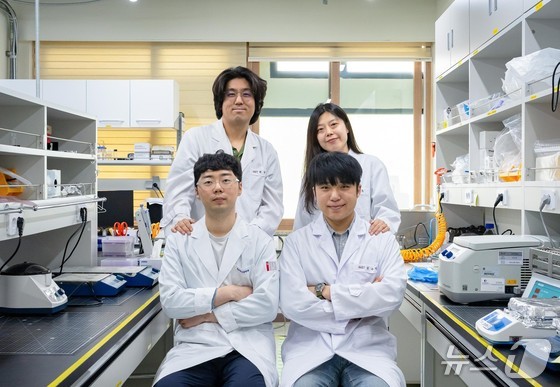
Gwangju Institute of Science and Technology (GIST) announced on Thursday that a research team led by Professor Jeong Hyun-ho from the Department of Electrical and Computer Engineering has developed a groundbreaking optical coating technology.
Inspired by penguin feather structures, this innovative coating can remove moisture and repel rainwater without the need for an external power source.
This technology is expected to provide a stable foundation for autonomous vehicles to receive Light Detection and Ranging (LiDAR) signals reliably, even in harsh weather conditions.
The research team was inspired by the nanoscale melanosomes found in penguin feathers, which simultaneously maintain body temperature and provide waterproofing in extreme environments. These melanosomes absorb light to generate heat, while the feathers’ microscopic surface structure prevents water droplets from adhering.
Building on this principle, the team developed a plasmonic helical structure composed of three-dimensional silica (SiO₂) containing copper (Cu) nanoparticles.
The coating incorporating this plasmonic helical structure maintained over 80% transmittance in the near-infrared range (905 nm) used by autonomous vehicle LiDAR systems. Remarkably, it could rapidly remove moisture using only sunlight.
Experimental results revealed that under typical sunlight conditions, the surface temperature increased by approximately 9.3℃ (about 48.74°F), with moisture eliminated within six seconds. Real-world outdoor LiDAR tests and durability assessments confirmed stable signal reception and excellent optical and water-repellent performance.
Professor Jeong stated that they’ve introduced a novel optical platform that simultaneously removes moisture and provides water-repellent functionality using only sunlight, without interfering with LiDAR signals. This technology has the potential to enhance the reliability of various outdoor optical systems, including autonomous vehicles, robots, drones, and smart windows.
The research, co-authored by graduate students Lee Joo-hyung and Kim Gyu-rin under Professor Jeong’s guidance, was published online in the prestigious journal Nature Communications on June 27.
For inquiries regarding technology transfer, interested parties can contact the Technology Commercialization Center.