

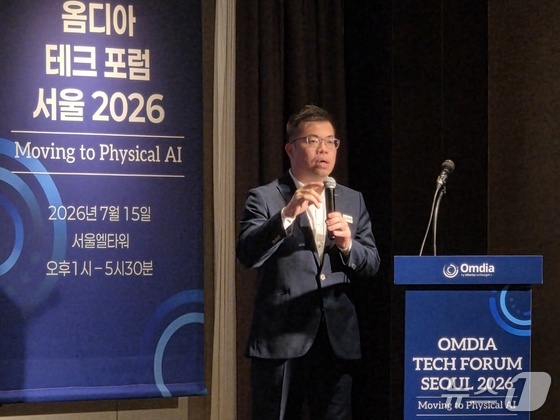
“The key to the humanoid robot race is not the AI model itself, but how effectively data can be collected and trained for real-world environments.”
That was the assessment of Lian Jye Su, principal analyst at Omdia’s Singapore office. Speaking at the “Omdia Tech Forum Seoul 2026” held July 15 at El Tower in Seocho-gu, Seoul, he said during a session titled “New Possibilities and Challenges of Physical AI” that “South Korea has sufficient potential to grow into a third robotics supply chain connecting the United States and China.”
He said that for the humanoid robot industry to enter a phase of mass adoption, securing data and building an ecosystem must take priority over improving hardware performance.
He also emphasized that a collaborative structure involving not only manufacturers but also semiconductor companies, cloud providers, telecommunications companies and software firms will determine the success or failure of the industry.
“Data, Not AI, Will Drive Competitiveness… Training Centers and Ecosystem Development Are Key”
Su said most humanoid robots currently operate based on vision-language-action (VLA) models, but pointed out that they still lack sufficient real-world data needed to behave naturally like humans.
“Humans predict and perform their next actions based on visual information rather than language,” he said. “Robots also need a process of continuously collecting data from real environments and learning from it.”
To achieve this, he said building training centers that replicate actual production environments, similar to those in China, is important. These facilities can collect vast amounts of data through teleoperation and human motion capture while improving AI models.
Using airport baggage handling as an example, he explained that even a simple task like moving luggage can be extremely challenging for robots because lighting conditions, weight and shapes vary significantly. He added that developing general-purpose humanoid robots requires data that reflects the diversity of real-world environments.
He also identified outdoor equipment inspections as a major use case. However, he explained that such applications require a combination of ultra-low latency 5G networks, high-resolution video transmission, remote operation systems, cloud-based data storage and AI training environments.
“Humanoid robotics is an ecosystem industry that cannot be solved by a single company alone,” Su said.
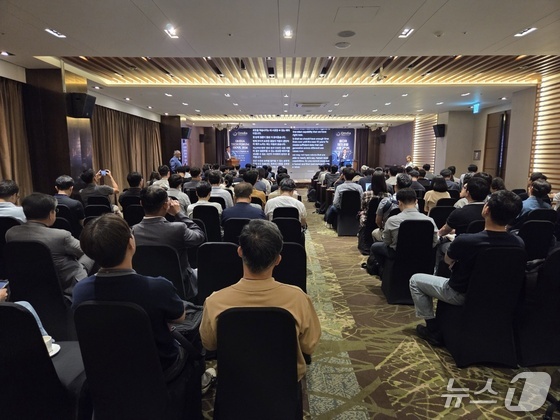
Business representatives attend a lecture at the “Omdia Tech Forum Seoul 2026” held July 15 at El Tower in Seocho-gu, Seoul. July 15, 2026 / News1 reporter Hwang Jin-joong
“South Korea Can Become a Third Supply Chain Alternative to the U.S. and China”
Su predicted that robotics will increasingly become an area of “technological sovereignty,” similar to semiconductors.
“Countries are likely to seek robot supply chains that do not rely entirely on the United States or China,” he said. “In that process, South Korea can play the role of a third supply chain that serves as an alternative to both countries.”
He identified South Korea’s supply chains built through industries such as automobiles, as well as its global distribution and service networks, as key competitive advantages. While Chinese companies have strong price competitiveness, they face limitations in global system integration (SI) and maintenance support, creating opportunities for South Korean companies, he said.
He also emphasized that company-specific data will become a more important competitive advantage than AI model performance.
“Data generated by companies in Singapore and data generated by companies in Taiwan are different because their operating environments themselves are different,” Su said. “The key is not simply having the best AI model, but collecting the data a company needs, training it for the specific environment and applying it to real-world operations.”
He also predicted that the era of household humanoid robots is still about 10 to 15 years away. He said the industry is currently at a stage of advancing technology in limited environments such as research and development, education, data collection, manufacturing and logistics. He expects the technology to eventually expand from industrial settings into everyday life, including household assistance and elderly care.
“General-purpose humanoid robots can only enter daily life once key technologies such as multimodal AI, world models, reinforcement learning and swarm intelligence mature,” Su said. “This is the most important period for accumulating data and building an ecosystem.”