

U.S. President Donald Trump’s “decision” to bring North Korea to the negotiating table appears to have ended in failure, at least for now. After the United States and South Korea spent the past four days moving quickly amid expectations of reduced joint military exercises and renewed dialogue with North Korea, Pyongyang responded with a blunt message: it has “no interest whatsoever.”
Kim Yo Jong, the sister of North Korean leader Kim Jong Un and the official overseeing the country’s external affairs, said in a statement titled “Position on Major International Issues” issued late on Aug. 19 that North Korea had no intention of accepting the reduction in U.S.-South Korea joint military exercises that Trump had presented as a “conciliatory measure.” She called the move “not worthy of comment and of no interest.”
Kim Yo Jong also denied Trump’s recent claim that he had communicated with Kim Jong Un. She went so far as to mock the claim, saying it was “perhaps the only matter related to our top leadership’s foreign policy that I am unaware of.”
North Korea’s Kim Yo Jong Rebuts Trump’s Claims in Late-Night Statement, Draws Line Under Dialogue
On Aug. 15 (local time), Trump posted a photo of himself with Kim Jong Un during their June 2019 meeting at Panmunjom on his social media platform Truth Social, expressing familiarity with the North Korean leader.
On Aug. 16 (local time), he said, “Given that I have a very good relationship with Kim Jong Un, I am unhappy that the United States agreed long ago to participate in joint military exercises with South Korea,” and ordered a reduction in the joint exercises.
On Aug. 17 (local time), during an exchange with reporters, Trump also said Kim Jong Un had “responded” to his proposal, suggesting that North Korea had expressed interest in talks with the United States.
As Trump continued making these “bombshell remarks,” U.S. and South Korean authorities moved quickly. The U.S. and South Korean defense ministries immediately discussed scaling back the second-half regular joint exercise, Ulchi Freedom Shield (UFS), which began Aug. 17. The exercise was shortened from the originally planned 11 days to five, with only the “defense exercise” portion of the original “defense and counterattack exercise” being conducted, effectively cutting the exercise in half in a push to implement Trump’s directive.
South Korea’s Foreign Ministry focused on the possibility of a “rapid breakthrough” in U.S.-North Korea dialogue, maintaining close communication with Washington while sharing related information with neighboring countries, including China. It also sought to emphasize that the reduction in the joint exercise was intended to promote “peace on the Korean Peninsula.”
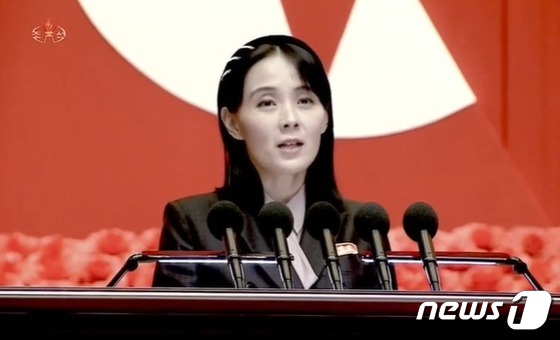
However, these measures appear to have been insufficient to move North Korea. In her statement, Kim Yo Jong referred to joint military exercises involving the Army, Navy and Air Force conducted by the United States and South Korea since the beginning of the year, as well as the first-half regular joint exercise Freedom Shield, and claimed that “the exercise they say they have reduced this time has already been replaced by other exercises.”
She particularly argued that “reducing the scale or duration of the exercises does not change the nature of provocative and aggressive military exercises,” saying that merely adjusting the “tone” of U.S.-South Korean military cooperation was not enough.
Kim Yo Jong also said, “The reality remains unchanged that the greatest threat to the security interests of our state and the regional security environment comes from the United States,” adding that “if the U.S. side promotes the measures it has taken this time as a ‘goodwill measure,’ it will not receive the response it wants.”
North Korea Repeatedly Calls for a Policy Shift and Recognition as a Nuclear State, Maintaining a Higher Bar for Dialogue
However, it may be difficult to conclude from Kim Yo Jong’s statement alone that North Korea has completely lost interest in diplomacy with the United States.
Although Kim Yo Jong denied that Trump and Kim Jong Un had communicated, she also said, “Our head of state, Kim Jong Un, has stated on several occasions that he personally has good memories and feelings toward Trump,” adding that “the relationship between the two leaders is excellent, and this is something the whole world knows and should not be surprised by.” This could be interpreted as suggesting that U.S.-North Korea dialogue remains possible through a decision by Kim Jong Un, the country’s “top leader.”
At the same time, Kim Yo Jong maintained that “the U.S. hostile policy toward the DPRK has never changed,” and argued that “regardless of the excellent relationship between the two leaders of the DPRK and the United States, it is both common sense and essential for us to exercise our sovereign rights to deter forces that threaten our security.”
She also claimed that “history and reality have proven that the regional security structure can become more balanced and stable when the Democratic People’s Republic of Korea possesses stronger deterrent capabilities.”
Kim Yo Jong’s remarks appear to be linked to North Korea’s long-standing demand for recognition of its status as a nuclear-armed state. North Korea has repeatedly argued that the development of its nuclear capabilities is an exercise of its sovereignty and an expression of its deterrent power in response to threats from the United States and its allies.
Taken together, Kim Yo Jong’s remarks can be interpreted as once again emphasizing a “higher bar for dialogue”: North Korea has no intention of engaging in talks in response to traditional “conciliatory measures” such as suspending or reducing joint military exercises, but may consider dialogue only if the United States withdraws various sanctions and other “hostile policies” toward North Korea and recognizes its status as a nuclear-armed state.
Reduction in Joint Exercise Yields Little, Leaving Gaps in Combined Defense Posture and U.S.-South Korea Communication
Given Kim Yo Jong’s statement that North Korea has not changed its stance of rejecting dialogue, the various measures taken by the United States and South Korea over the past four days are inevitably subject to criticism as actions that produced little tangible result.
For South Korea in particular, the decision to follow Trump’s measures and statements in an effort to ignite momentum for renewed dialogue with North Korea has left Seoul in the awkward position of having effectively “warmed the stove” without producing meaningful results.
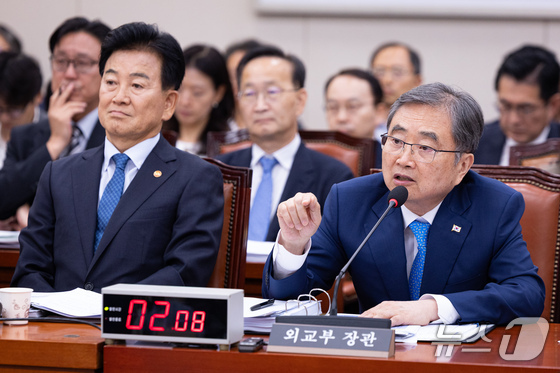
South Korean Foreign Minister Cho Hyun, who appeared before the National Assembly’s Foreign Affairs and Unification Committee that day, expressed optimism, saying he believed Trump’s decision “has created a new starting point that could bring about changes in inter-Korean relations.”
Unification Minister Chung Dong-young, who also appeared before the committee, said, “President Trump’s decision came from his deliberations over peace and stability on the Korean Peninsula,” adding that “the Ministry of Unification supports President Trump’s decision.”
However, with North Korea showing no change in its stance, analysts say the government’s expectations appear to have once again turned into an uncertain hope.
In particular, strong criticism has emerged that the United States and South Korea made a major “diplomatic blunder” by taking the unprecedented step of scaling back a joint exercise that had already begun, potentially creating gaps in the combined defense posture and disrupting the transition of wartime operational control.
The episode has also given the Trump administration a painful reminder of the “Trump risk.” Both the U.S. Defense Department and State Department reportedly had no prior knowledge of plans to reduce the joint exercises until Trump announced the decision on social media.
After Trump’s announcement, the South Korean government contacted the U.S. ambassador to South Korea and activated all channels through its embassy in Washington in an effort to determine Trump’s “true intentions.” However, the U.S. administration reportedly was unable to provide a definitive answer, exposing a communication gap between the two allies.