

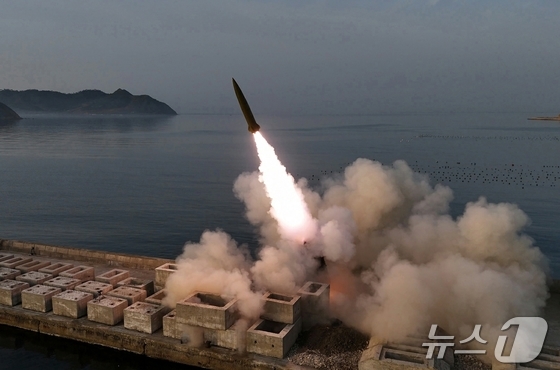
On the Thursday afternoon, North Korea launched a barrage of over ten short-range ballistic missiles (SRBMs) into the East Sea. This marks the 12th missile provocation this year and the resumption of military demonstrations after approximately a week-long pause.
Through a statement from Kim Yo Jong, Deputy Director of the Workers’ Party, North Korea rejected U.S. President Donald Trump’s conciliatory gestures, including the scaling back of the joint U.S.-South Korea exercise Ulchi Freedom Shield (UFS). Military analysts interpret North Korea’s high-intensity provocation, occurring just one day after Kim’s statement, as a deliberate effort to underscore its hostility toward the U.S. and South Korea.
The Joint Chiefs of Staff reported that at approximately 5:00 p.m. (Korean time), they detected North Korea firing over ten short-range ballistic missiles from the vicinity of Pyongyang into the East Sea. The missiles traveled approximately 300 kilometers (about 186 miles), with South Korean and U.S. authorities currently conducting detailed analysis to determine exact specifications.
The statement added that South Korean and U.S. intelligence agencies have been tracking and sharing relevant intelligence from the onset of the launch. Information regarding North Korea’s ballistic missiles has also been shared with Japan. The military emphasized its readiness, stating that the forces maintain the capability and posture to respond overwhelmingly to any provocation while closely monitoring North Korea’s activities under the robust U.S.-South Korea alliance.
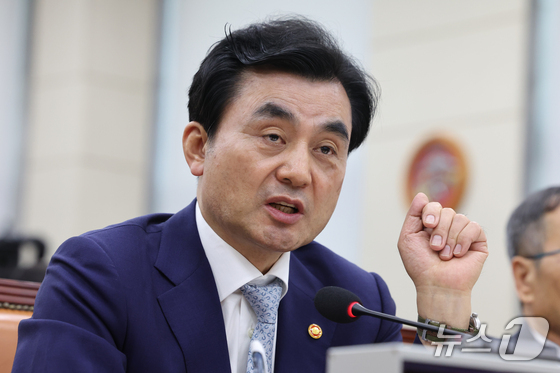
During a parliamentary defense committee meeting, Minister of National Defense An Kyu-back stated that the missiles were likely fired from 600mm multiple rocket launchers, and that their trajectory was tracked continuously from launch through flight to impact.
This latest provocation from North Korea is the first since the commencement of the second phase of UFS on Monday, occurring eight days after they launched a single ballistic missile into the East Sea from Wonsan on August 12. Prior to that, on August 6, North Korea also fired one SRBM into the East Sea from the Wonsan area.
The military provocations on August 6 and 12 involved single missile launches, reportedly displaying new trajectories. This led to speculation that North Korea was conducting test launches as part of efforts to improve its missile capabilities.
However, the recent provocation employed a strategic approach of launching multiple missiles simultaneously, likely aimed at overwhelming enemy defense systems. Defense experts view this as a clear threat message, irrespective of President Trump’s directive to scale back joint U.S.-South Korea exercises.
On August 16, President Trump stated on social media that, given his very good relationship with Kim Jong Un, he was displeased with the longstanding U.S. agreement to participate in joint military exercises with South Korea. While noting it was too late to cancel the drills entirely, he instructed former Secretary of Defense Pete Hegseth to significantly reduce the scale of the joint exercises. This statement coincided with the scheduled start of UFS exercises in South Korea.
In response, the U.S. and South Korea, which had initially planned to conduct joint exercises from August 17 to 27, agreed to conclude the exercises early on August 21 at the request of the U.S.
In a statement released late on August 19th, Deputy Director Kim Yo Jong emphasized that the unchanging reality is that the greatest threat to our national security and regional stability emanates from the U.S. She underscored the importance of recognizing the ongoing joint military exercises between South Korea and the U.S. as a clear expression of hostility toward North Korea.
This latest provocation is interpreted as North Korea’s refusal to acknowledge President Trump’s scaling back of U.S.-South Korea joint exercises as a conciliatory measure, reaffirming its view of the U.S. as an adversarial nation.