

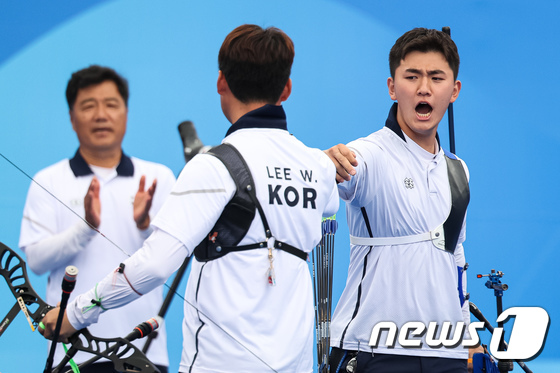
South Korea’s archery team, widely regarded as the world’s best, is set to redeem itself at the upcoming Asian Games after a disappointing performance in Hangzhou three years ago. The team is poised to reclaim its position at the pinnacle of Asian archery.
The 2026 Aichi-Nagoya Asian Games will feature a total of 10 gold medals in archery, evenly split between recurve and compound categories. Both disciplines will include individual, team, and mixed team events for men and women.
South Korea has long dominated the archery medal table at the Asian Games. Since the sport’s official inclusion in the 1978 Bangkok Games, South Korea has claimed an impressive 46 out of 70 gold medals awarded. Japan follows with 8, India with 6, and China with 4.
South Korea’s supremacy is particularly evident in recurve archery, where they have virtually no equal.
Recurve archery, using traditional bows without mechanical aids, challenges archers to hit targets 70 meters away. Individual competitions consist of five sets of three arrows each, team events have four sets of six arrows, and mixed team events feature four sets of four arrows. Set scoring determines the winner, with 2 points for a win, 1 for a tie, and 0 for a loss.
South Korea’s recurve dominance has been absolute, sweeping all gold medals in the discipline at the 1990 Beijing, 1998 Bangkok, 2006 Doha, and 2010 Guangzhou Games.
Even at the recent Hangzhou Games, South Korea’s recurve archers maintained their reputation, securing four gold medals across men’s and women’s team events, mixed team, and women’s individual competition.
For the upcoming Games, South Korea aims to maintain its stronghold in recurve archery.
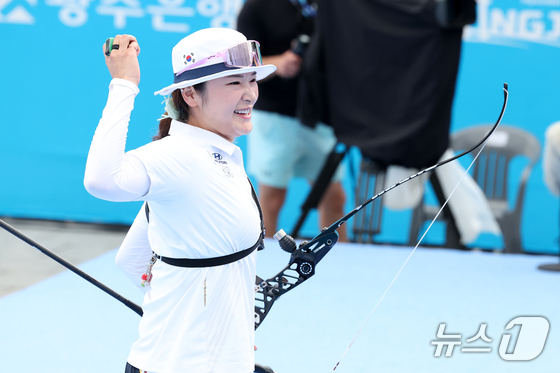
The men’s team features the formidable trio of Kim Woo-jin, Kim Je-deok, and Lee Woo-seok, who swept all gold medals in men’s individual, team, and mixed team events at the 2024 Paris Olympics. The women’s squad is led by veteran Kang Chae-young, alongside rising stars Oh Ye-jin and Lee Yoon-ji.
However, China and India pose potential threats. China has shown improvement in recent World Cup events, while India is rapidly enhancing its recurve program. Japan and Taiwan are also looking to challenge South Korea’s dominance.
In contrast to recurve, South Korea faces a tougher battle in compound archery.
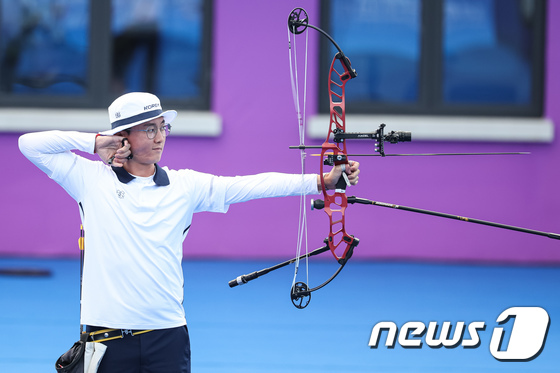
Compound archery utilizes bows equipped with pulleys and sights, with competitors aiming at targets from 50 meters (about 164 ft). Unlike recurve, compound scoring is cumulative rather than set-based.
South Korea has yet to establish the same level of dominance in compound as it has in recurve. Meanwhile, India has heavily invested in compound archery, emerging as a powerhouse on the international stage.
This shift was evident at the Asian Games three years ago, where India swept all five gold medals in compound events, including men’s and women’s individual, team, and mixed team competitions. This upset prevented South Korea from claiming the overall archery title.
Notably, India defeated South Korea 235-230 in the men’s team final and secured both gold and silver in the men’s individual event.
As South Korea prepares for a rematch after three years, the compound team has undergone some changes.
The men’s team now consists of Kim Jong-ho, Choi Yong-hee, and Choi Eun-kyu, while Park Ye-rin, Park Jung-yoon, and Kang Yeon-seo make up the women’s squad.
Park Jung-yoon, a newcomer to the national team, has already shown promise by scoring a perfect 150 in the women’s individual event at a World Cup event in July.
Despite these changes, expectations for the compound team remain cautious.
South Korea failed to reach the podium in any of this year’s four World Cup events in compound archery. In contrast, India medaled four times and China twice. India also clinched gold in the men’s team event at the Madrid World Cup in July.
However, South Korea is not resting on its laurels. With compound archery set to debut at the 2028 Los Angeles Olympics, the country is focused on improving its competitiveness in this discipline. The Asian Games serve as a crucial stepping stone in this journey.
If South Korea can maintain its recurve dominance while narrowing the gap in compound, it could reclaim the top spot in overall archery medals for the first time in eight years. Archery events at the Asian Games are scheduled from September 26 to October 3.