

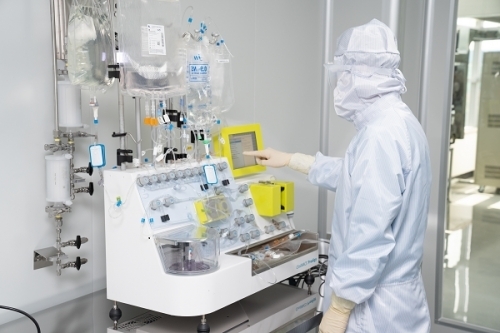
AbClon announced on Wednesday that its collaborative project with Sweden’s Strike Pharma to develop a targeted in vivo CAR-T therapy has been officially approved as part of the Eurostars international joint technology development program. This initiative is overseen by the Ministry of Trade, Industry and Energy and the Korea Industrial Technology Association (KIAT).
The project’s core objective is to develop StAb19, a next-generation in vivo CAR-T candidate, by integrating Strike Pharma’s targeted delivery platform with AbClon’s proprietary antibodies. The total project budget is set at up to 1 million EUR (approximately 1.16 million USD), with domestic research and development costs amounting to 1.49 billion KRW (about 1.08 million USD), including 1 billion KRW (roughly 724,000 USD) in government funding.
The collaboration will combine Strike Pharma’s pTAG targeted delivery technology with AbClon’s self-developed CAR antibody sequence h1218. The pTAG technology selectively targets T cells to deliver genetic material.
AbClon’s h1218 antibody is unique in that it targets a different binding site than the FMC63 antibody commonly used in existing CAR-T therapies. With this technology, AbClon aims to develop an in vivo CAR-T candidate that stands out from current treatments.
In vivo CAR-T technology represents a significant advancement in cancer treatment. Unlike traditional methods that require extracting, modifying, and reinfusing T cells, this approach generates CAR-T cells directly within the patient’s body. This next-generation technique is expected to streamline the treatment process, reducing manufacturing time and treatment duration while improving accessibility.
Through this partnership, AbClon is also expanding its technical capabilities in the in vivo CAR-T field. The company is currently collaborating with GC Biopharma on mRNA-LNP-based in vivo CAR-T development, pursuing a dual-track strategy that applies its proprietary antibody technology to different delivery platforms.
As part of the Eurostars project, the two companies plan to optimize the StAb19 candidate and conduct preclinical research. Their goal is to compile the necessary data package for an Investigational New Drug (IND) application.
An AbClon spokesperson stated that by merging Strike Pharma’s targeted delivery technology with our proprietary antibodies, it has established a promising new in vivo CAR-T pipeline. Combined with the ongoing collaboration with GC Biopharma, this positions us to enhance the technological capabilities in the in vivo CAR-T field and potentially lead the global market.
AbClon, established in June 2010 by Chief Executive Officer (CEO) Lee Jong-seo and a team of Korean and Swedish antibody researchers, is a biopharmaceutical company focused on developing antibody-based drugs. Since its inception, the company has been engaged in new antibody discovery and drug development. In 2014, AbClon was selected for a pan-ministerial new drug development project, which accelerated its efforts in developing HER2-targeted antibody drugs.
In 2015, AbClon entered into a joint development agreement with Seoul National University’s Industry-Academic Cooperation Foundation for CAR-T therapies. The following year, it licensed the technology for its HER2 antibody drug candidate AC101 to Shanghai Henlius Biotech in China.
After its KOSDAQ listing through a technology exception in September 2017, AbClon expanded its focus to include both antibody drugs and CAR-T therapies. In 2018, the company was awarded a government project to develop a new CD19 antibody-based CAR-T therapy. This led to the advancement of its CD19 CAR-T candidate AT101 (now known as Nespecel), which received approval for Phase 1 and 2 clinical trials in 2021.
Recently, AbClon has broadened its technological scope beyond autologous CAR-T therapies. The company is now involved in developing mRNA-LNP-based in vivo CAR-T therapies with GC Biopharma and targeted delivery-based in vivo CAR-T treatments with Strike Pharma, showcasing its commitment to innovation in cancer treatment.