

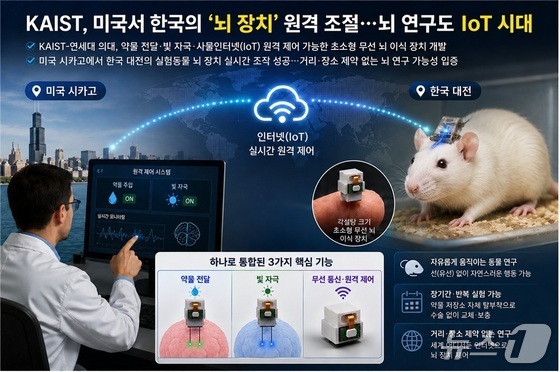
In a groundbreaking development, U.S. researchers can now remotely control a miniature brain implant in Korea via the internet. A team of Korean scientists has engineered a wireless device capable of delivering drugs and precisely manipulating brain neurons using light from anywhere across the globe.
On Thursday, the Korea Advanced Institute of Science and Technology (KAIST) announced a collaborative breakthrough. A team led by Professor Jeong Jae-woong from the Department of Electrical and Electronic Engineering, in partnership with Professor Kim Hwa-young from Yonsei University’s College of Medicine, has successfully developed an Internet of Things (IoT)-based wireless neural implant. This cutting-edge device integrates drug delivery, light stimulation, wireless communication, and remote control capabilities.
To push past physical constraints, the research team connected the brain implant to the internet. This innovative approach allows researchers to administer drugs or stimulate specific brain neurons in real-time without being physically present in the laboratory. The device can also be programmed to operate automatically at predetermined times.
Roughly the size of a sugar cube, the device allows test animals to move freely with minimal interference. This design eliminates the need for researchers to repeatedly manipulate equipment near the subjects, reducing stress from human presence that could skew animal behavior and experimental outcomes.
The device houses a sophisticated microfluidic system for precise drug delivery to targeted brain areas, alongside micro light-emitting diodes (LEDs) for controlling specific neurons with light. Researchers can fine-tune drug delivery and light stimulation independently or in tandem.
For added convenience, the drug reservoir features a magnetic attachment system, allowing for easy removal and refilling when supplies run low.
The team implanted the device in live mice, validating its performance over a four-week period. In a remarkable demonstration of the technology’s capabilities, a researcher in Chicago successfully operated the brain implant in Daejeon, South Korea, in real-time via the internet. This feat proves the device’s reliability across vast international distances.
Furthermore, the researchers demonstrated the ability to suppress addiction-related behaviors by administering cocaine to mice brains while simultaneously stimulating specific neurons with light. This achievement opens new avenues for studying brain circuits through combined drug delivery and light stimulation.
This technological breakthrough holds immense potential for long-term studies on the interplay between brain circuits and behavior in free-moving animals. However, the research team cautions that additional preclinical validation, rigorous safety assessments, and medical device approval processes are necessary before clinical applications can be considered.
Looking ahead, the team plans to develop a remote and automated platform for collaborative use across multiple research institutions. They aim to expand their research into intelligent implantable devices for treating various brain disorders.
The technology is expected to revolutionize research on conditions that gradually alter brain function and behavior, such as addiction, depression, and neurodegenerative disorders. There’s also potential to develop intelligent implantable medical devices that combine brain state-sensing technology with artificial intelligence to deliver targeted drugs or neural stimulation as needed.
Professor Jeong expressed optimism about the long-term applications, stating that it anticipates this technology will pave the way for developing intelligent implantable medical devices for diagnosing and treating brain diseases.
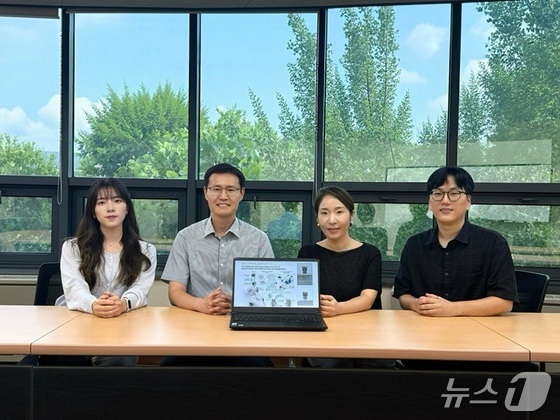
Professor Kim emphasized the broader implications, noting that this will serve as a crucial research tool for unraveling the complex causal relationships between brain circuits and behavior across various disease models.
The groundbreaking research, co-authored by KAIST doctoral candidate Jeong Eun-young and Yonsei University doctoral researcher Park Jong-woo, has been published in the prestigious international journal Science Advances.