

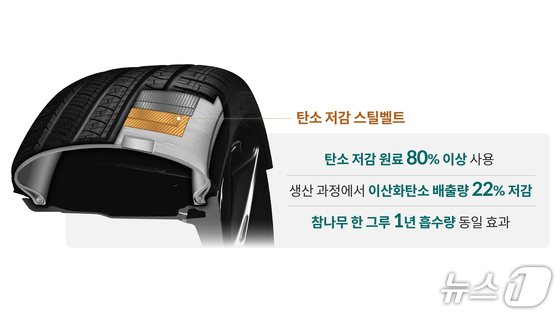
Hyundai Motor Company (Hyundai) and Kia have successfully developed a groundbreaking tire technology that can reduce carbon emissions by more than 3 kg (about 6.6 pounds) per vehicle.
On Tuesday, Hyundai and Kia announced the development of an innovative steel belt tire that not only delivers superior performance but also significantly reduces carbon dioxide emissions during the manufacturing process through advanced material technology.
In response to international agreements and various regulations, global automakers are intensifying efforts to reduce carbon emissions throughout their products’ entire life cycle, from raw material extraction to manufacturing, transportation, operation, and disposal.
Hyundai and Kia are accelerating the development of various technologies to reduce carbon emissions across their entire value chain, aiming to achieve carbon neutrality by 2045. In 2023, they established a collaborative research partnership with Hyundai Steel, HS Hyosung Advanced Materials, and Hankook Tire to develop world-class carbon-reducing steel belt tires.
The steel belt is a critical component made of steel wire inserted into the tire’s inner rubber layer. It supports the tire’s load while minimizing twisting and deformation, thereby enhancing driving safety and durability. Unlike the rubber that wears down during use, the steel belt must maintain consistent performance throughout the tire’s lifespan, requiring strict quality standards and high strength.
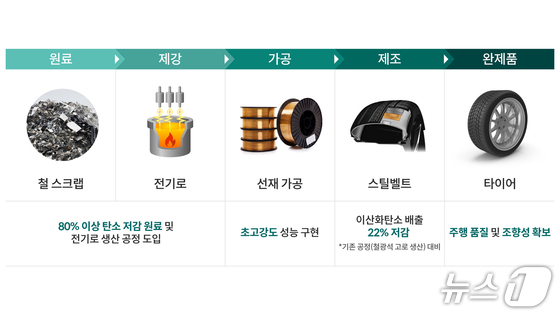
Through their collaborative research efforts, Hyundai and Kia have successfully developed a steel belt that significantly reduces carbon emissions during manufacturing by utilizing recycled steel scrap and electric furnaces.
Traditionally, steel belts were produced by melting iron ore in blast furnaces. However, the new carbon-reducing steel belts use over 80% recycled materials, primarily steel scrap. Hyundai and Kia report that this approach allows for a 22% reduction in carbon dioxide emissions during production.
This innovation translates to a reduction of more than 3 kg (about 6.6 pounds) of carbon emissions per vehicle, comparable to the annual carbon dioxide absorption of a single oak tree.
The automakers have applied a specialized heat treatment process optimized for recycled materials, achieving ultra-tensile (UT) grade performance. This ensures stable driving dynamics and steering precision even under challenging road conditions.
Tires equipped with these carbon-reducing steel belts are slated for gradual implementation in future Hyundai Motor Group vehicles.
Hong Seung-hyun, Senior Vice President at Hyundai and Kia’s Basic Materials Research Center, stated that the carbon-reducing steel belt technology represents more than just corporate innovation. Further, it’s the result of collaborative efforts among Korea’s leading companies across the value chain, from materials to finished vehicles, united under the common goal of a sustainable future. He added that they are committed to further refining this technology to ensure it becomes a significant milestone in its journey towards carbon neutrality for future generations.