

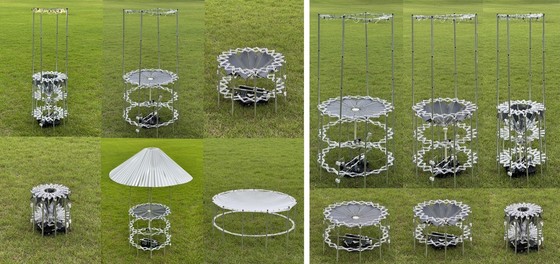
Researchers at the Korea Institute of Science and Technology (KIST) have created an innovative modular robot furniture system designed for outdoor use, clinching the top prize at an international robot design competition. This versatile robot interacts with its environment, including natural light and users, transforming into various forms such as an umbrella-equipped table, hammock, and storage units.
KIST announced on Wednesday that Dr. Kwak So-na and Dr. Lim Yun-seop from the Institute’s Intelligence and Interaction Research Center presented their robotic furniture system, dubbed OnOBOT, at the RO-MAN 2025 conference in Eindhoven, Netherlands, this August.
RO-MAN, a premier international conference in human-robot interaction, annually attracts leading research institutions worldwide to showcase their latest innovations. This year’s robot design competition featured three categories: Contextual Design, Technical Design, and Demonstration. Alongside KIST, other notable participants included Honda Research Institute Europe and the University of Auckland.
The award-winning OnOBOT is an evolution of the researchers’ previous work on oOoBOT, an indoor micro modular robot furniture system. The team designed this new furniture system to accommodate both indoor and outdoor environments, particularly targeting mobile living spaces like Tiny Houses on Wheels (THoW).
OnOBOT consists of various modules including tables, chairs, storage units, carts, umbrellas, hammocks, and lamps. It boasts both mobility and adaptability, enhanced by contextual awareness and automation features. This allows the robot to interact with its surroundings and autonomously adjust the space.
For example, the umbrella and lamp modules can detect changes in natural light – such as sunlight, moonlight, and starlight – and modify their forms accordingly. Indoors, they utilize holographic film materials to recreate various natural ambiances, like seascapes, sunsets, and sky views, by altering lighting brightness and color.
Each module can be freely folded or expanded, maximizing space efficiency. This flexibility makes it particularly suitable for compact environments such as recreational vehicles (RVs) or mobile homes.
The research team envisions that OnOBOT’s interconnected modules could potentially evolve into an Internet of Things (IoT)-based smart home system. They anticipate its applications expanding into tourism, leisure industries, and sustainable housing solutions.
Dr. Kwak stated that they’re aiming to showcase OnOBOT at the Consumer Electronics Show (CES) 2026 to gain recognition for its innovative design. The ongoing research is focused on this goal. She added that the key challenges in the commercialization process include durability testing and refining the system based on user feedback.
This research was supported by the Ministry of Trade, Industry and Energy’s Robot Industry Technology Development Project (2MRF150) and the Design Innovation Capability Enhancement Project (2MRF850).