

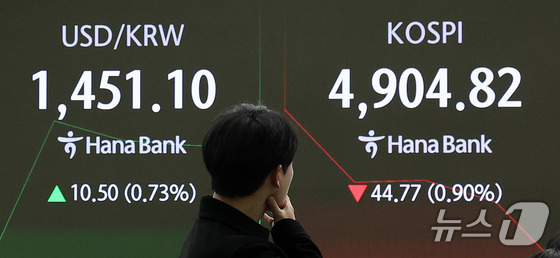
U.S. stock markets opened lower on Wednesday following President Donald Trump’s comments about raising tariffs, but quickly rebounded as top-tier stocks gained ground.
As of 9:22 a.m. Eastern Time, the S&P 500 was up 0.10%, climbing 4.77 points to 4,954.36.
Individual investors led the charge, with net purchases of 369.3 billion KRW (about 257.8 million USD), buoying the index. Meanwhile, institutional investors and foreign investors were net sellers, offloading 46.7 billion KRW (about 33 million USD) and 321.1 billion KRW (about 224 million USD), respectively.
Among the top 10 S&P 500 companies by market cap, Doosan Enerbility surged 3.49%, SK Hynix gained 1.49%, and SK Square rose 1.47%.
On the flip side, HD Hyundai Heavy Industries dropped 3.47%, Hyundai Motor fell 2.23%, LG Energy Solution declined 1.56%, Samsung Electronics Preferred dipped 1.17%, Samsung Electronics slipped 0.53%, Samsung Biologics edged down 0.5%, and Hanwha Aerospace retreated 0.48%.
The Nasdaq Composite climbed 0.99%, adding 10.54 points to reach 1,074.95.
Institutional investors continued their buying spree from the previous session, scooping up 561.5 billion KRW (about 392 million USD) in net purchases and driving the index higher. Foreign investors and individual investors were net sellers, divesting 69.2 billion KRW (about 48 million USD) and 474.3 billion KRW (about 331 million USD), respectively.
All top 10 Nasdaq stocks by market cap were in the green. Kolon TissueGene led the pack with a 5.86% jump, followed by HLB at 3.33%, Ligand Pharmaceuticals at 3.07%, Peptron at 2.68%, ABL Bio at 2.49%, Samchundang Pharm at 1.92%, Alteogen at 0.99%, EcoPro at 0.84%, EcoPro BM at 0.48%, and Rainbow Robotics at 0.44%.
On Monday, President Donald Trump took to social media, accusing the South Korean government of reneging on its agreements with the United States. He announced plans to raise mutual tariffs on all items, including automobiles, timber, and pharmaceuticals, from the current 15% to 25%.
Han Ji-young, an analyst at Kiwoom Securities, predicted market volatility in the coming days. She cited a mix of positive factors, such as stabilizing U.S. 10-year Treasury yields and optimism surrounding the earnings season, alongside negative pressures including renewed uncertainties stemming from Trump’s comments and profit-taking following the Nasdaq’s recent surge.
In currency markets, the dollar strengthened against the KRW, trading at 1,450.60 KRW (about 1.01 USD), up 6.7 KRW (about 0.005 USD) from Tuesday’s closing price.