

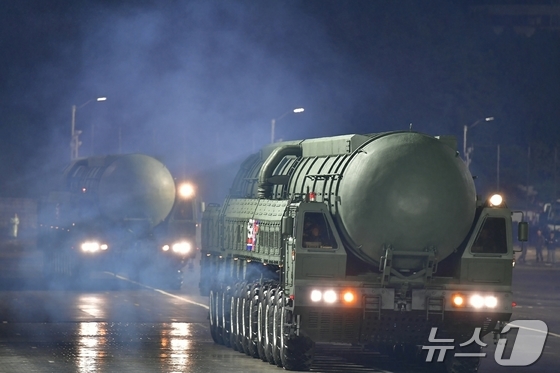
North Korea may acquire the intercontinental ballistic missile (ICBM) Hwasong-21 by the mid-2030s, according to recent intelligence assessments. The Hwasong-21 is projected to be an enhanced version of the Hwasong-20, a medium-range ICBM first revealed during the Workers’ Party’s 80th anniversary parade last October, featuring a more compact and lighter nuclear warhead.
A report titled, Evaluation and Outlook of North Korea’s New ICBM Hwasong-20, released on February 7 by Shin Seung-ki, a researcher at the Korea Institute for Defense Analysis (KIDA), suggests that North Korea is likely to unveil a new five-year military power construction plan during the upcoming 9th Party Congress, slated for February 2026-2030.
This plan is expected to prioritize the development of advanced strategic nuclear weapons with significantly improved capabilities, including increased payload capacity and range. During this five-year period, Pyongyang is anticipated to focus on developing the new ICBM, the Hwasong-20.
Based on analysis of available imagery and footage, Shin concluded that while the Hwasong-20 demonstrates improved payload efficiency compared to its predecessor, the Hwasong-19, it still falls short of the capabilities of large ICBMs deployed by the U.S. and Russia.
The report indicates that the Hwasong-20’s airframe closely resembles that of the Hwasong-19, with the exception of the warhead section. The Hwasong-20’s warhead appears more rounded, suggesting an effort to expand internal space for additional reentry vehicles, including nuclear warheads. North Korean data implies that the Hwasong-20’s propulsion system diameter has increased by 14.3%, with an overall volume growth of approximately 30.6% compared to the Hwasong-19.
Furthermore, the Hwasong-20 is expected to incorporate a new solid rocket motor with enhanced thrust, potentially allowing it to carry 6 to 8 nuclear warheads—an increase of 2 to 3 over the estimated 4 to 5 for the Hwasong-19. Given that the Hwasong-20 is an upgraded iteration of the Hwasong-19, Shin predicts that North Korea will concentrate on its development during the 9th Party Congress period.
However, as the Hwasong-20 remains in the medium-class category, it may struggle to penetrate advanced U.S. missile defense systems. When compared to the large ICBMs of the U.S. and Russia, its capabilities are still limited. This assessment leads to the conclusion that North Korea is likely to continue developing the ICBM Hwasong-21, which could potentially carry around ten nuclear warheads.
Shin stated that assuming consistent structure, materials, and propellant composition across the first, second, and third stages, the estimated launch weight of the Hwasong-20 is around 86 tons, factoring in the improved thrust. This indicates a payload efficiency improvement of about 17% over the Hwasong-19, but it still lags behind the large solid rocket motor ICBMs fielded by the U.S. and Russia.
He further noted that North Korea is expected to continue enhancing its propulsion systems, guidance and control systems, while also pursuing miniaturization and weight reduction of nuclear warheads and reentry vehicles. Their ultimate goal appears to be developing systems comparable to U.S. and Russian propulsion technologies, such as those used in the LGM-118A Peacekeeper and RT-23 Molodets, aiming to field an ICBM capable of carrying around ten nuclear warheads by the mid-2030s.