


The impact of the Trump administration’s tariff pressure is expected to urgently affect Google and Apple’s request to export high-precision map data. Observers anticipate that the government may make a decision this week on the companies’ requests, which were repeatedly deferred last year.
High-precision maps are a security complex that contains information about secure facilities and detailed geographical data. While major countries worldwide use 1:25,000-scale map data, the Korean government holds an overwhelmingly superior 1:5000 high-precision map. This has made Google and Apple eager to obtain this 1:5000 map data.
The United States is exerting political pressure on what began as an industrial dispute, arguing that Korea’s refusal to allow the export of map data amounts to discrimination against U.S. companies. It appears they are using this as leverage to pressure South Korea on tariffs, rather than focusing on the map data itself.
Both political parties and academic circles maintain that the export should not be allowed. Primarily, there are concerns about security and defense information embedded in high-precision maps that are being leaked to foreign companies. Moreover, there are significant concerns that providing world-class, high-precision maps, created with taxpayer money, to American companies that pay no corporate taxes and are not subject to Korean laws could widen the economic gap by offering free, high-quality learning data for autonomous driving and AI.
Critics argue that this isn’t discrimination against American companies, but rather reverse discrimination against Korean operators who comply with local laws and fulfill their obligations.
According to IT industry sources on Thursday, South Korea’s Ministry of Land, Infrastructure and Transport is likely to convene a meeting of the “Surveying Results Foreign Export Council,” composed of relevant ministries, at the National Geographic Information Institute this week to decide on the export of 1:5000 scale high-precision maps.
A ministry official explained that the meeting schedule, including the date, will be determined after consultation with relevant departments, and nothing has been decided yet.
Previously, in November last year, the government postponed the export decision for the third time, asking Google to supplement its documents by accepting some conditions, such as blurring security facilities and limiting coordinate displays. Google submitted supplementary documents on February 5. Apple, whose decision was also deferred last December, is awaiting final judgment this year.
The United States is pressuring for the export of high-precision maps, arguing against discrimination against its companies. Last November, both countries agreed to facilitate the cross-border transfer of information, including location and personal data, through a joint fact sheet.
The issue is whether Google and Apple will fulfill responsibilities commensurate with the high-precision map data they built with taxpayers’ money. Exporting maps without establishing data centers or paying corporate taxes could result in reverse discrimination against Korean companies.
In response, the government has proposed establishing domestic data centers as a condition for map exports, in addition to security facility blurring and coordinate display limitations, which Google agreed to before submitting supplementary documents.
Google has not yet officially accepted the terms for establishing the data center. Apple specified in last year’s export application that data storage would be limited to three data centers in Korea, the U.S., and Singapore, but it’s unclear whether they will build data centers on purchased land subject to domestic law or operate through leasing.
Without domestic data centers, there are concerns about sensitive information leaking as information processing isn’t restricted to Korea. Moreover, as they are not Korean corporate entities, there’s a high likelihood of avoiding corporate taxes in proportion to their earnings.
According to reports from the Financial Supervisory Service’s electronic disclosure and National Assembly audits, Google Korea paid about $12.9 million in corporate tax on its 2024 revenue. While Google Korea reported sales of $290.18 million in South Korea, its actual revenue, including YouTube and the Google Play Store, could be in the trillions of won. During the same period, Naver and Kakao paid about $292.65 million and $119.25 million in corporate taxes, respectively. Google paid only about 4% of the corporate taxes paid by Naver and Kakao.
Google Korea’s alleged tax avoidance has been a recurring topic in annual parliamentary audits. When questioned about exact sales figures and operating profits in Korea, they have never transparently disclosed this information, citing the headquarters’ policy. When confronted about tax evasion allegations, they arrogantly denied their tax obligations in Korea, stating they are a U.S. company under California state law.
The Korean government’s emphasis on domestic data center construction in relation to the high-precision map export is likely due to this background. Purchasing land and constructing buildings in Korea would require formal corporate registration procedures and subsequent financial reporting under various laws, enabling proper corporate tax assessment.
Korean map service providers like Naver, Kakao, and T Map Mobility use high-precision maps to create added value through navigation services and pay taxes. Map processing is conducted in physically controlled secure areas using dedicated terminals disconnected from external internet networks for security purposes.
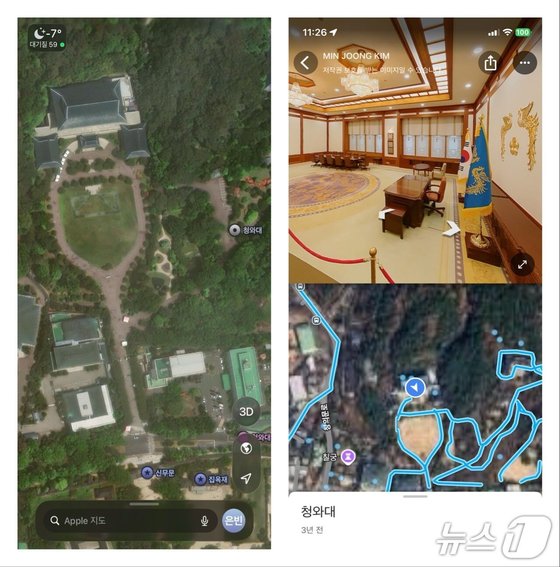
Threats to security and data sovereignty have shown signs even before the map export. The government previously rejected similar requests from Google twice, in 2007 and 2016, citing security reasons.
In January this year, Apple Maps exposed satellite images of key facilities at the Blue House, a top-level national security site, without any blurring. Google Maps also left satellite images of the Blue House and interior photos taken during its public opening unobscured.
In response, the Blue House requested that both Google and Apple blur the security facilities. Currently, Apple Maps’ satellite images of the Blue House main building and surrounding areas are blurred, with place names not displayed. Google Maps doesn’t show place names, but separate blurring hasn’t been applied yet.
Last August, Google’s weather service map incorrectly labeled Dokdo as “Takeshima” and the East Sea as the “Sea of Japan.” During a National Defense Committee audit last October, Hwang Sung Hye, Vice President of Google Korea, explained that Google services use neutral language because they are used globally.
While the Korean government agrees that map exports pose a threat to security and domestic industry, it’s struggling to decide how to respond. It appears to be caught between intensifying U.S. tariff pressure and strong opposition from academic and industrial sectors.
If the Korean government provided map data at the same 1:25,000 scale as other countries, concerns could be significantly reduced. Google and Apple provide various map services, including navigation, public transit information, and store details, using 1:25,000 scale map data from other countries.
However, in Korea, they persistently demand 1:5000 high-precision maps while using the Korean government’s lack of map data provision as an excuse to offer extremely limited services. Navigation guidance, public transit information, and details about restaurants or shopping malls are inadequately provided.
While Korean citizens can use domestic map services like Naver Maps or Kakao Maps without inconvenience, foreign tourists visiting Korea find it quite difficult to navigate Korea with Google Maps.
The government currently maintains that exporting high-precision maps is difficult.
Last October, Defense Minister Ahn Gyu Baek emphasized during a parliamentary audit that the Defense Ministry’s basic stance is to allow foreign exports only if there are no security risks. Land Minister Kim Yun Deok also stated internally that the export of maps is definitely not allowed.
However, concerns are being raised that the government’s position may change now that high-precision map exports have become a trade issue.
Kim Ju Wan, a senior researcher at the Electronics and Telecommunications Research Institute, warned that high-precision map data serves as high-quality learning data for AI giants like Google. He stated that if high-precision maps are incorporated into Google’s AI models, it could weaken Korean industrial competitiveness by providing not only detailed location information about every corner of Korea but also becoming industrial foundation data that can be converted into the digital world.